One of the more unusual animals I have encountered around Buntzen Lake is the Rough-skinned Newt (Taricha granulosa).
I have walked the trails around Buntzen Lake hundreds of times and have only noticed these newts on about three occasions. They are remarkably easy to miss. Their brown colouring blends extremely well with wet leaves, gravel, and the trail surface, and when I have encountered them they have often remained almost completely still.
From my own observations, I have generally seen them on trails fairly close to water. That fits their semi-aquatic life cycle and preference for moist forest, wetlands, ponds, lakes, and slow-moving water.
A Rough-skinned Newt on Pumphouse Road
I photographed the newt below on Pumphouse Road, only a short distance from the bridge. I almost walked right past it because it blended into the road so well.
When I originally posted the photograph online, there was some discussion about whether it might be a Western Red-backed Salamander. Ivan Phillipsen, of Wild Pacific Northwest, identified it as a Rough-skinned Newt.
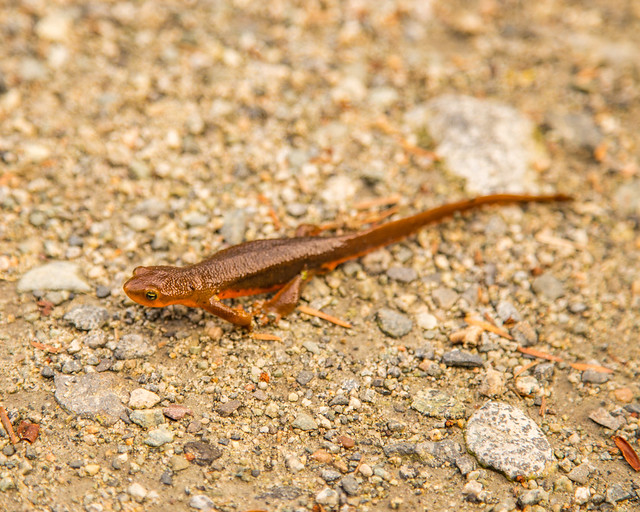
Rough-skinned Newt (Taricha granulosa) on Pumphouse Road at Buntzen Lake.
Why Are They So Hard to Notice?
From above, a Rough-skinned Newt can be remarkably well camouflaged. Adults are usually brown, dark olive, or greyish-brown on top, with dry-looking, granular skin.
The striking part is underneath. Rough-skinned Newts have a bright yellow to orange belly, which acts as a warning to predators.
When threatened, a newt may arch its head and tail upward to expose the bright underside. This defensive posture is called an unken reflex.
The newt I photographed became extremely rigid and barely moved. At the time I wondered whether this was some type of defence mechanism, and that behaviour is consistent with the passive defensive response seen in Rough-skinned Newts.
Rough-skinned Newts can be very difficult to see when they are motionless on a trail. If you encounter one, give it space and allow it to move on its own. They are particularly worth watching for on damp trails and near water.
They Are Toxic
The Rough-skinned Newt has one of the most unusual defence systems of any animal around Buntzen Lake.
Its skin contains tetrodotoxin, or TTX, a powerful neurotoxin that discourages most predators. The bright orange underside acts as warning colouration.
The toxin is dangerous if swallowed and should not be allowed to contact the eyes, mouth, open cuts, or other mucous membranes. The safest approach is simply not to handle the newt.
Dogs should also be kept away from them. A dog that bites or mouths a Rough-skinned Newt could potentially be exposed to the toxin.
Newts and Garter Snakes: An Evolutionary Arms Race
One of the most fascinating things about Rough-skinned Newts is their relationship with the Common Garter Snake (Thamnophis sirtalis).
Some populations of Common Garter Snakes have evolved resistance to tetrodotoxin, allowing them to prey on Rough-skinned Newts that would be highly toxic to most other predators.
In areas where snakes have greater resistance, natural selection favours newts with stronger chemical defences. In turn, stronger toxins favour snakes with even greater resistance.
This back-and-forth adaptation between predator and prey is a classic example of coevolution and is often described as an evolutionary arms race.
A Life Split Between Water and Forest
Rough-skinned Newts are semi-aquatic. They return to ponds, lakes, wetlands, and slow-moving streams during the spring breeding season.
Females lay individual eggs attached to aquatic vegetation. The eggs hatch after several weeks, producing aquatic larvae with external gills.
After metamorphosis, young newts move into the surrounding forest. Outside the breeding season, adults and juveniles can spend much of their time under logs, bark, leaf litter, and other moist cover.
Unlike many salamanders, Rough-skinned Newts sometimes move about openly during the day, especially during wet conditions. Their toxic skin gives them some protection from predators.
Rainy Weather Is a Good Time to Watch for Them
Amphibians generally become more active at the surface during wet weather, and Rough-skinned Newts are no exception.
If you are walking around Buntzen Lake during or shortly after rain, particularly on trails near the shoreline, wetlands, or creeks, it is worth keeping an eye on the ground.
I have only encountered a few despite spending a great deal of time around the lake, so seeing one still feels like a fairly special wildlife encounter.
How Long Do Rough-skinned Newts Live?
Rough-skinned Newts are longer-lived than their small size might suggest. They may live for around 12 years.
The newly metamorphosed juveniles spend several years growing in terrestrial habitat before returning to water as breeding adults.
Leave Them Where You Find Them
If you see a newt at Buntzen Lake, the best approach is to observe it without touching it.
If it is sitting on the trail, simply watch your step, give it some room, and make sure anyone walking with you sees it as well. Because they can remain motionless and blend so well with the trail surface, accidental trampling is probably a greater concern than deliberate disturbance.
For more information about amphibians found in British Columbia, see the Province of British Columbia amphibian information.