


Hiking around Buntzen Lake can be wonderfully rewarding, but the surrounding mountains deserve respect. A familiar trail can become difficult when daylight fades, the weather changes, or snow hides the route. Fortunately, dedicated volunteer search and rescue teams are ready to help when emergencies occur. The best approach is to prepare carefully and know your limits before heading out.

Who Is Coquitlam Search and Rescue?
Coquitlam Search and Rescue (SAR) is a volunteer charitable organization serving the Tri-Cities, Anmore, Belcarra, and a large surrounding response area. Its work includes wilderness and inland-water search and rescue, with terrain extending from Indian Arm towards Pitt Lake and beyond. Buntzen Lake and Eagle Ridge fall within this area.
Its volunteers train, prepare equipment, and respond when people become lost, injured, or stranded. These operations can involve demanding ground searches and specialized rescue techniques. Volunteers contribute their time without being paid for search and rescue work. The organization receives public support and funding, but donations also help provide training and equipment.
Coquitlam SAR’s message is straightforward: don’t be afraid to ask for help. Waiting can make a rescue more difficult, especially as darkness or bad weather approaches. You do not have to wait 24 hours before reporting someone missing in the backcountry.
Know Your Limits Before Choosing a Hike
One of the most important hiking decisions happens before you leave the parking lot: choosing a route that fits your experience, fitness, and the day’s conditions. Having completed an easier route once does not necessarily mean you’re ready for a much harder one.
My preferred progression for hikers building towards the more difficult local routes is:
Lakeview Trail
Be extremely comfortable completing this hike, without finishing tired, before attempting Diez Vistas.
Diez Vistas
Build enough endurance and confidence to complete this route very comfortably before considering demanding Eagle Mountain hikes.
Eagle Mountain Routes
Lindsay Lake Loop, Swan Falls Loop, and similar routes require greater preparation and judgement.
This is personal trail advice, not an official difficulty rating or a guarantee of safety. Physical fitness is only part of the equation. Navigation skills, terrain, weather, snow, and the ability to make sound decisions matter just as much.
Mountain Conditions Can Be Very Different from the Parking Lot
The Buntzen Lake parking lot may be completely snow-free while upper elevations on Eagle Mountain are covered in deep snow. In some years, steep snow-covered sections can persist into early summer. Significant snow and ice are also possible in winter, including January. Soft snow can be exhausting to travel through, while hard snow or ice on steep terrain can be dangerous.
Snow can cover the trail itself and conceal markers or junctions. Signs can also become damaged or difficult to read. Never rely exclusively on signs, and don’t assume you can safely follow a summer route under winter conditions. Check elevation-appropriate forecasts and trail reports before leaving, and be prepared to change your plans.

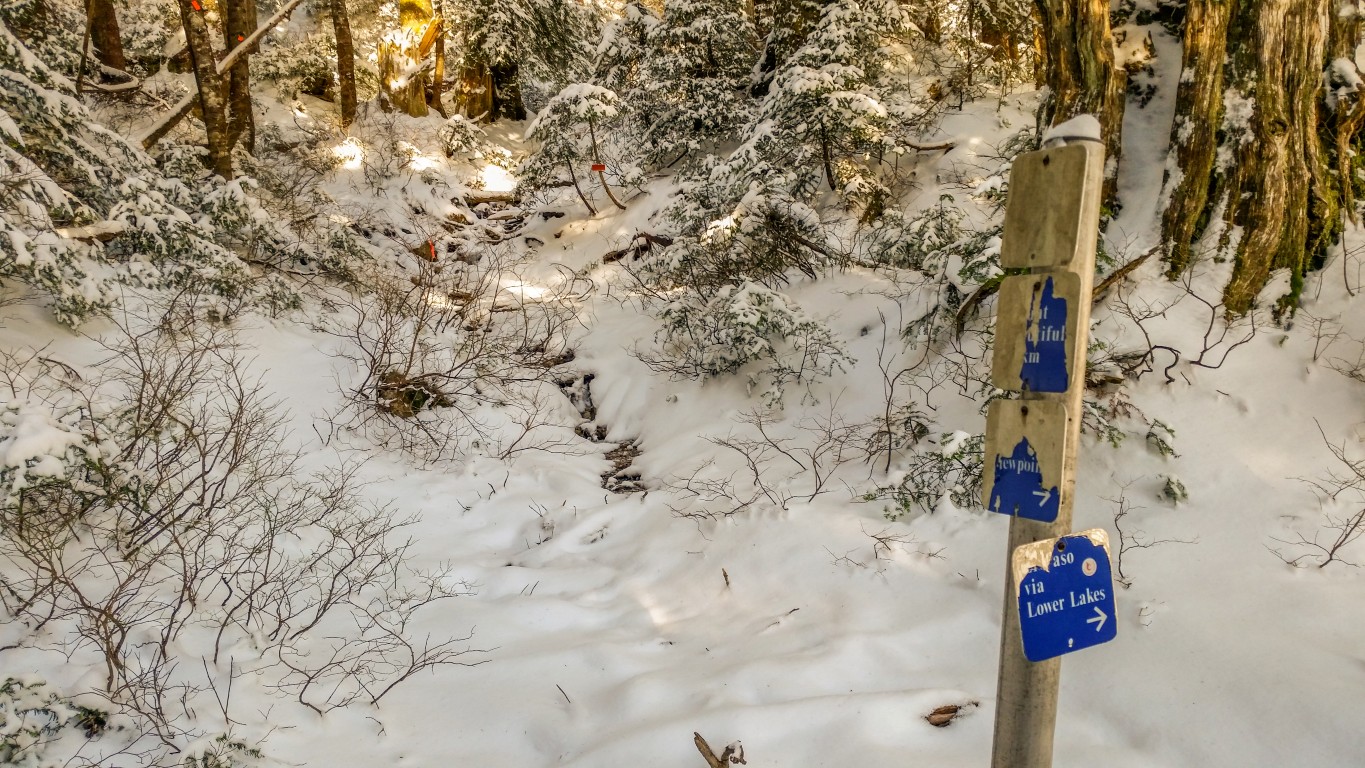
Know when to turn back. If you lose the trail, can’t confidently determine your position, or encounter conditions beyond your abilities, stop and reassess. Turn around when you can safely retrace your route; don’t continue blindly. On complex terrain, the safest choice depends on your location, the available routes, and the conditions.
Plan for Daylight and Buntzen Lake Gate Closing Times
Reaching a summit or viewpoint is only part of the hike. You must still have sufficient daylight, energy, and time for the descent and return to the parking lot. Mountain slopes and dense forest can become dark before the official sunset time, particularly in late autumn and winter.
Check Buntzen Lake’s current gate closing time before starting. BC Hydro adjusts closing times throughout the year, generally in step with changing daylight hours. Plan to reach your vehicle comfortably before the published closing time, with a margin for delays. Carry a headlamp even if you expect to finish during daylight. See the Buntzen Lake Parking and Gate Hours guide and BC Hydro’s official recreation-area information.
Hiking Preparation: The Ten Essentials
Coquitlam SAR and AdventureSmart stress trip planning, appropriate training, and carrying essential equipment. Tell a trusted person your intended route, who is with you, and when to expect you back. Agree on when they should raise the alarm if you don’t return.
Even for a familiar day hike, carry the Ten Essentials, and know how to use them:
- Headlamp or flashlight, with spare power
- Fire-starting equipment for emergencies, where safe and legally permitted
- Whistle or another signalling device
- Extra food and water
- Extra warm, windproof, and waterproof clothing
- Map, compass, and suitable navigation and communication devices
- First aid kit
- Emergency shelter or blanket
- Pocket knife or multi-tool
- Sun protection
Carry additional equipment suited to the season and terrain. A phone with downloaded offline maps can be useful, but batteries fail and cellular service can be unreliable around Buntzen Lake. Know how to navigate without a cellular connection; consider a satellite emergency communicator on remote routes. Footwear traction devices do not, by themselves, make steep icy terrain safe.
What If You Become Lost or Injured?
Stop before making the situation worse. Take a moment to assess your position, surroundings, weather, and the condition of everyone in your group. If you are injured, stranded, cannot safely find your route, or need emergency assistance, call 911 promptly. Explain where you started, your intended route, where you believe you are, and any injury or immediate hazard.
After calling, follow the emergency dispatcher’s instructions, conserve phone battery, keep warm and dry, and avoid unnecessary movement. Staying in a safe location generally makes it easier for rescuers to find you than wandering farther into unfamiliar terrain. If there is no cellular service, a satellite emergency device may provide another way to request help. Don’t wait for an arbitrary 24-hour period when someone is missing.
Real Rescues on Buntzen Lake Trails
Coquitlam SAR’s own incident reports show that these risks are real, even close to a popular recreation area:
Swan Falls: Snow Buried the Trail Markers (March 2018)
Two hikers became stranded at about 850 m elevation when deep snow concealed the route. They called for help as darkness approached. Search teams reached them late that night and assisted with the difficult descent.
Read Coquitlam SAR’s original report →Swan Falls: A Late Start (July 2014)
Two hikers departed the parking lot at about 2:30 p.m. and were caught by darkness after reaching the mountain summit. They called for help and remained in place until SAR volunteers escorted them out.
Read Coquitlam SAR’s original report →The lesson is not that every difficult hike ends in a rescue. Rather, planning, realistic limits, reliable navigation, and timely decisions can prevent a manageable problem from becoming a serious emergency.
Supporting Coquitlam Search and Rescue
Coquitlam SAR volunteers give their time and skills to help people in difficult circumstances. Community donations help the organization maintain equipment, provide training, and prepare for future emergencies. If you’ve enjoyed hiking around Buntzen Lake, supporting the volunteers who protect the surrounding backcountry is one meaningful way to give back.
Support Coquitlam Search and Rescue →The button opens Coquitlam SAR’s official donation page. Donations are made directly to the organization, not to BuntzenLake.ca.
About this page: BuntzenLake.ca is an independently maintained hiking and visitor-information website and is not affiliated with Coquitlam Search and Rescue or BC Hydro. The photographs reflect conditions on the dates indicated; trail conditions, signs, and access may have changed. Confirm current conditions and choose a route appropriate to your experience before heading out.