The forests around Buntzen Lake provide excellent growing conditions for an amazing variety of mushrooms and other fungi. With all the rain, damp forest floors, moss-covered logs, and decaying trees, there’s no shortage of places to find something interesting.
I’m a fun guy, but I’m certainly not a fungi expert! Over the years, I’ve photographed all sorts of mushrooms while hiking the trails around Buntzen Lake, particularly on the Diez Vistas and Lakeview trails.
October and November are especially good months for mushroom photography, when autumn rains encourage many species to produce their fruiting bodies. However, fungi can be found throughout the year, and some of the most interesting ones are easy to overlook.
Below are some of my mushroom photographs. I haven’t attempted to identify every species, so if you’re knowledgeable about fungi and recognize any of them, feel free to leave a comment!
Mushrooms Growing on Trees
Some of the most impressive fungi I’ve encountered have been growing directly out of tree trunks, logs, and old stumps.
The photograph below shows a group of mushrooms growing along the side of a tree. Many wood-decaying fungi produce mushrooms in clusters, sometimes appearing to emerge from the bark itself.
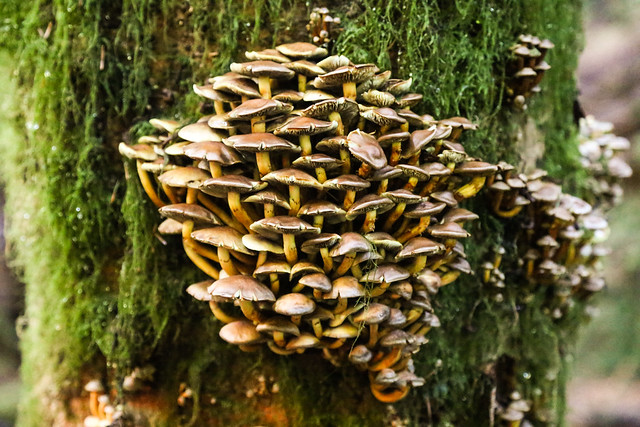
A group of mushrooms growing along the side of a tree.
The next photograph shows just how extensively mushrooms can spread across a tree trunk. It almost looks as though they’ve taken over the whole tree!
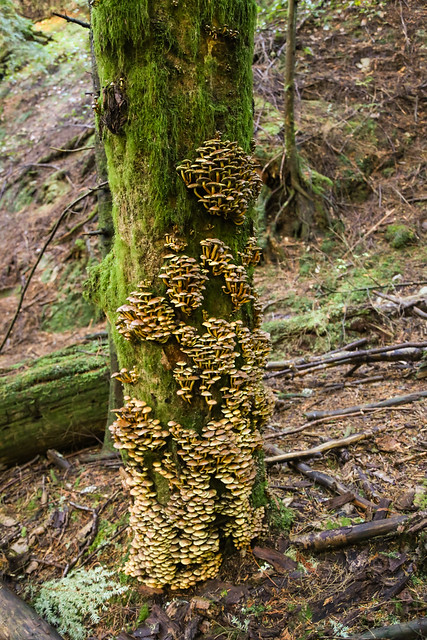
Mushrooms covering a substantial section of tree trunk.
And here’s another impressive collection growing from an old stump. Dead wood is an important habitat for fungi, providing both moisture and an abundant supply of organic material.
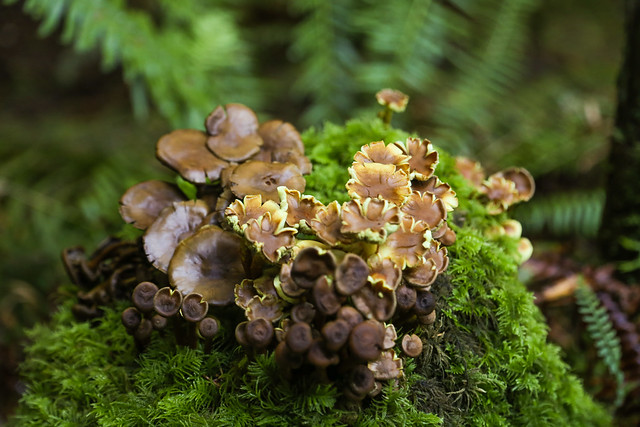
A stump providing an excellent home for fungi.
More Mushrooms Along the Trails
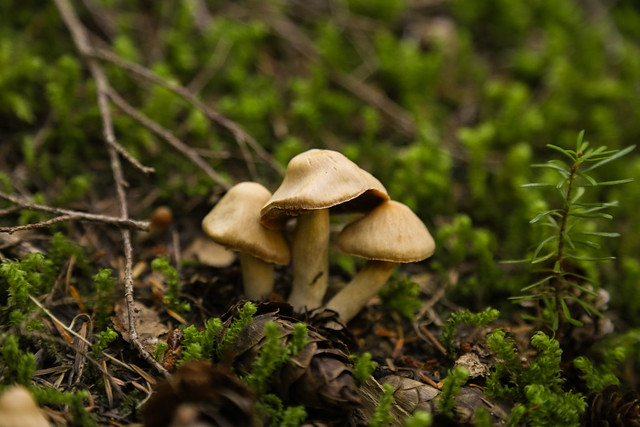
One thing I’ve noticed while hiking around Buntzen Lake is the variety of shapes, sizes, and colours. Some mushrooms grow individually, while others appear in groups. Some have the familiar mushroom shape, but others look quite unusual.
Here are three more examples I’ve photographed during my hikes.
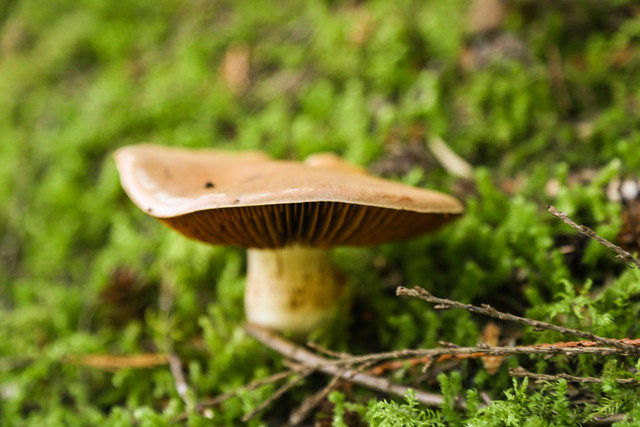
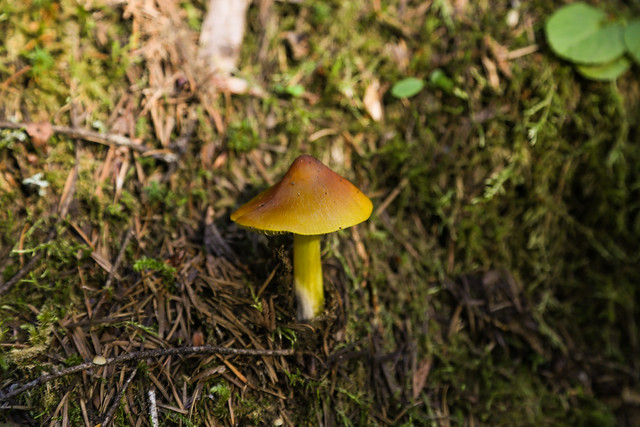
The visible mushrooms are actually just the reproductive structures of many fungi. Much of the organism can be hidden inside wood or beneath the forest floor as a network of fine threads called mycelium.
When conditions are favourable, the fungus produces mushrooms that release spores, allowing it to reproduce and spread.
Interesting Yellow Fungi
Below is an interesting yellow fungus I’ve noticed in several places around Buntzen Lake. Its bright colour certainly makes it stand out against the darker bark and forest surroundings.
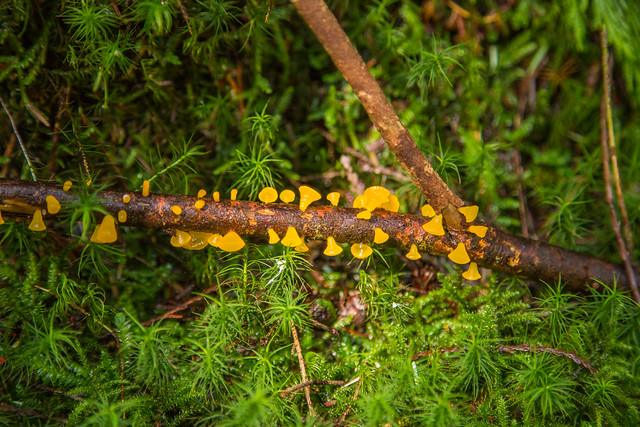
A bright yellow fungus that caught my attention.
Fungi come in a remarkable range of colours, including yellow, orange, red, purple, white, and almost black. Colour can sometimes help with identification, but it isn’t enough on its own to determine a species.
Are These Mushrooms Sweating?
The mushrooms in the next photograph look as though they’re sweating!
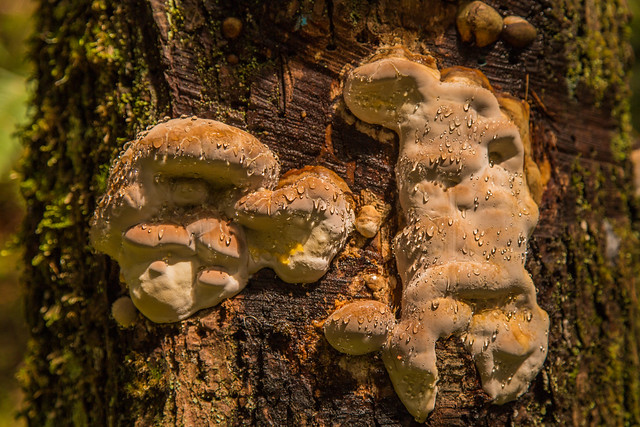
These mushrooms certainly look as though they’re sweating!
Some fungi can produce visible droplets through a process called guttation, in which liquid is released onto the surface. Moisture droplets can also come from rain, condensation, or dew.
I don’t know which process explains the droplets in this particular photograph, but it’s an interesting feature.
Tiny Mushrooms on the Forest Floor
Not all mushrooms are large or easy to see. Some are tiny and can be missed completely unless you slow down and look carefully.
Here are some little mushrooms I found along the trails.
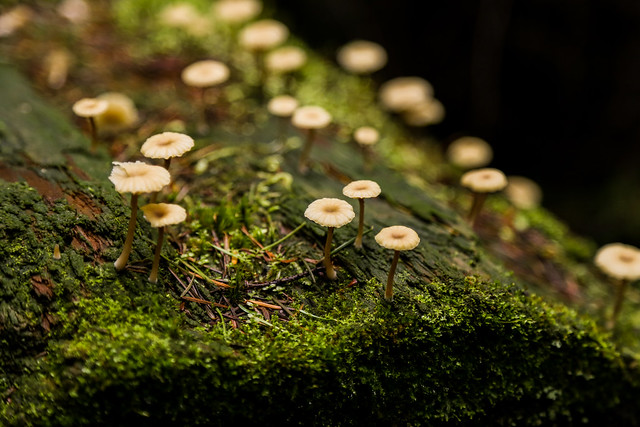
Some tiny mushrooms that would be easy to overlook.
Small mushrooms can be particularly rewarding to photograph close up. Even ordinary-looking fungi can reveal interesting shapes, textures, and colours when viewed from a different perspective.
Unusual Fungi on the Lakeview Trail
I’m not sure what the next one is, but I discovered it growing on an old stump along the Lakeview Trail.
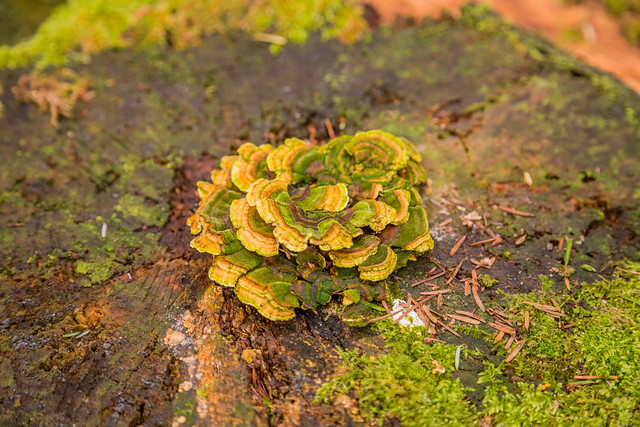
An interesting unidentified fungus on an old stump along the Lakeview Trail.
Some fungi specialize in breaking down wood, including the tough compounds that give tree trunks their strength. This decomposition is an essential part of the forest’s natural recycling process.
Without fungi and other decomposers, fallen branches, logs, and dead trees would accumulate much more slowly decomposing, and nutrients would not be returned to the soil as efficiently.
Mushrooms Growing From Dead Wood
Here’s a small mushroom I found growing from the end of a dead tree.
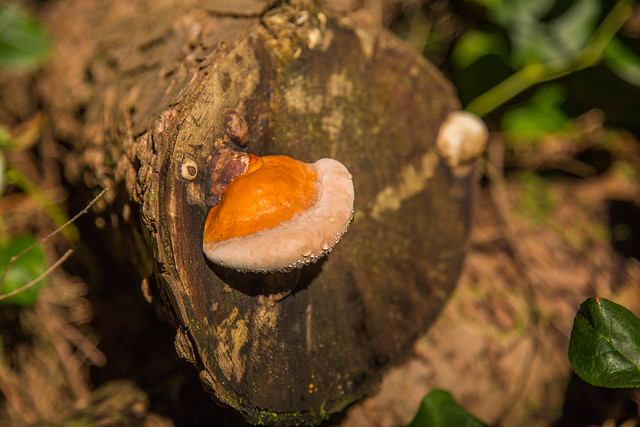
A small mushroom growing from dead wood.
The next mushroom looks fairly normal, at least compared with some of the unusual fungi in the other photographs!
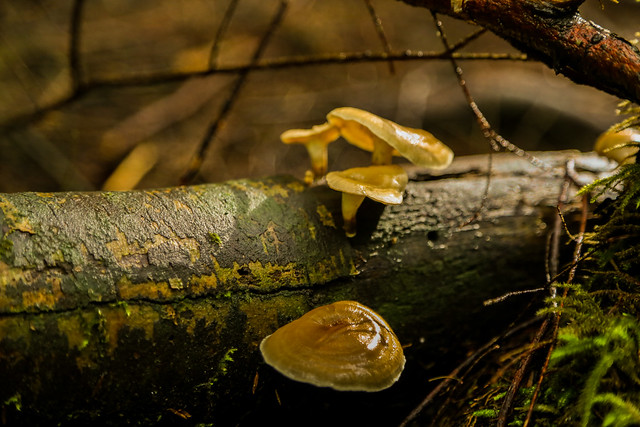
A more familiar-looking mushroom.
White Fungi Growing on a Tree
The next two photographs show a group of small, whitish fungi growing on a tree, followed by a close-up of the same growth.
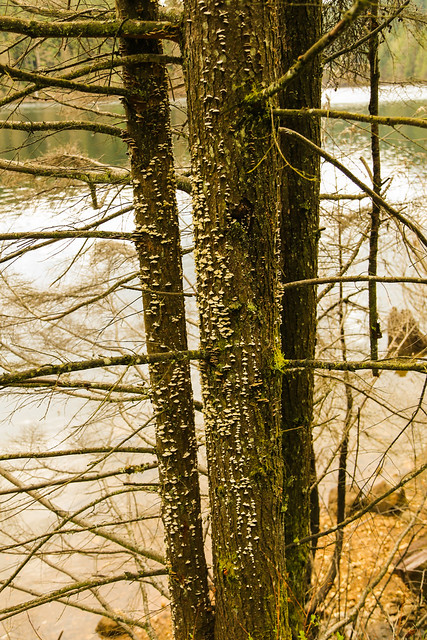
Small whitish fungi growing along a tree.

A closer look at the same fungi.
Close-up photography can reveal details that aren’t obvious from a distance. For mushroom identification, mycologists often examine the underside of the cap, whether the fungus has gills or pores, its stem, and the material on which it is growing.
Orange Mushrooms Along the Buntzen Lake Trail
And finally, here are some funky orange mushrooms I photographed along the eastern side of the Buntzen Lake Trail.
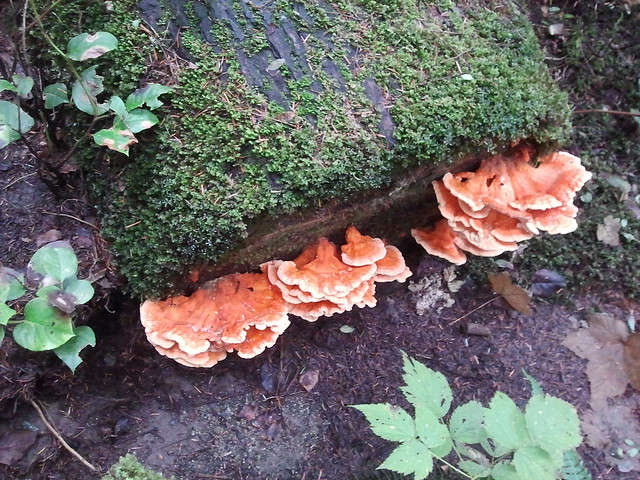
Some bright orange mushrooms along the Buntzen Lake Trail.
It’s amazing how much variety you can find simply by paying attention to the trees, stumps, and forest floor while hiking.
Interesting Facts About Mushrooms and Fungi
- Mushrooms are not plants: Fungi belong to their own biological kingdom. Unlike plants, they do not use sunlight to produce food through photosynthesis.
- Most of the fungus may be hidden: A mushroom is often only the visible fruiting body. Networks of microscopic fungal threads called hyphae can extend through soil, dead wood, and other materials.
- Fungi help recycle nutrients: Many fungi decompose fallen trees, leaves, and other organic material, returning nutrients to the forest ecosystem.
- Some fungi help living trees: Mycorrhizal fungi form partnerships with tree roots. The fungi help trees absorb water and nutrients, while the trees provide sugars produced through photosynthesis.
- Not all fungi grow mushrooms: The fungal kingdom includes yeasts, moulds, and many other organisms that don’t produce familiar mushroom-shaped structures.
- Autumn is an excellent time to look: Wet weather and cooler temperatures often encourage mushroom fruiting in coastal forests. However, different species appear at different times throughout the year.
- Some fungi can produce liquid droplets: Guttation is a process in which certain fungi release moisture onto their surfaces, sometimes making them appear to be sweating.
- Dead wood is important habitat: Fallen logs and old stumps support fungi, insects, and other organisms. As the wood decomposes, it contributes to the nutrient cycle and helps maintain forest biodiversity.
- Animals also depend on fungi: Various animals, including small mammals, eat mushrooms and other fungal structures. Some animals also help spread fungal spores.
Photographing Mushrooms Around Buntzen Lake
If you’re interested in photographing mushrooms, autumn is a particularly enjoyable time to explore the Buntzen Lake forests.
I find that looking at the sides of old tree trunks, decaying stumps, fallen branches, and mossy areas can reveal some interesting subjects. Sometimes the smallest mushrooms make the best photographs.
Try photographing fungi from different angles, including low to the ground, and look for interesting details such as gills, textures, and water droplets.
A little patience helps, especially when the forest is dark and damp. I also prefer to photograph mushrooms where they’re growing rather than disturbing them or removing them from the forest.
A Note About Mushroom Identification and Safety
Although I’ve included plenty of photographs, I haven’t identified these mushrooms to the species level. Many fungi look very similar, and accurate identification may require examining features that aren’t visible in a photograph.
Never eat a wild mushroom based solely on a photograph or an online identification suggestion. Some poisonous species closely resemble edible mushrooms, and mistakes can cause serious illness.
The purpose of this article is to appreciate and photograph the fungi growing around Buntzen Lake, not to provide a mushroom-foraging guide.
Please respect the natural environment, leave fungi and dead wood undisturbed, and stay on designated trails wherever possible.
Do You Recognize Any of These Mushrooms?
As I mentioned at the beginning, I’m a fun guy, but not a fungi expert!
If you recognize any of the mushrooms in my photographs, I’d be interested to hear your suggestions. Send me a message through my contact page and let me know which photograph you’re referring to and what species you think it might be.
Even after hundreds of hikes around Buntzen Lake, I still come across interesting fungi that I’ve never noticed before. That’s one of the things I enjoy about exploring these forests. There’s always something new to discover if you take the time to look.