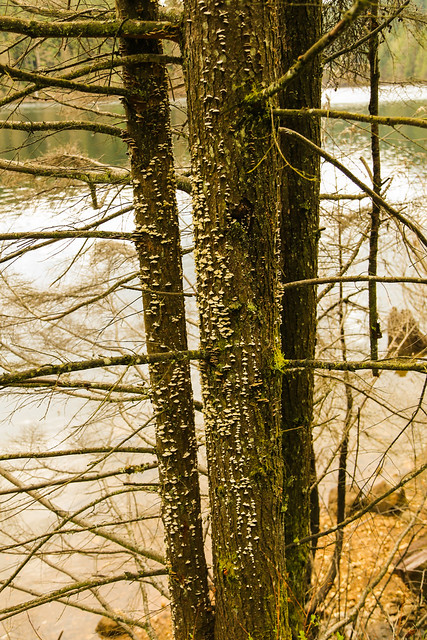
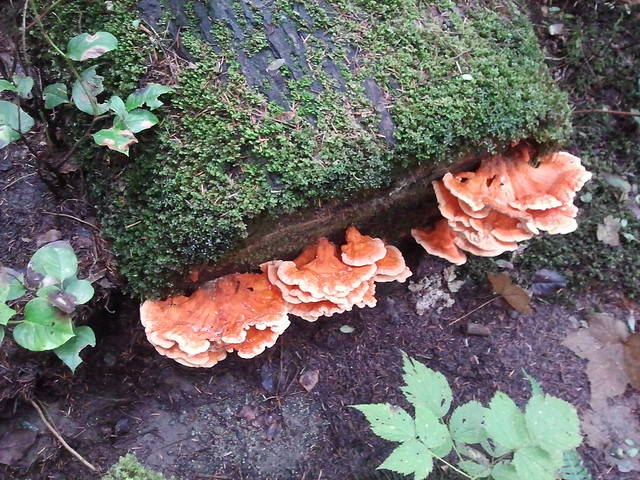
Tag Archives: Diez Vistas

Bear

Bear Safety at Buntzen Lake

Buntzen Lake is bear country. Black bears occasionally travel through the recreation area and surrounding forests, and BC Hydro regularly posts wildlife-awareness signs around the lake.

The bears found around Buntzen Lake are black bears, not grizzly bears. The safety guidance on this page is therefore focused on black bear encounters.

I have completed hundreds of hikes around Buntzen Lake and have probably seen bears only six or seven times. Most of those encounters have been uneventful, with the bear either ignoring me or moving away. That does not mean every encounter will be the same, so it is important to know what to do before you see one.

If you see a bear:
Stay calm, do not run, give the bear plenty of space, and slowly move away. Do not approach it for a photograph or block its escape route. Keep the bear in sight, but avoid staring directly at it. If you carry bear spray, keep it accessible and know how to use it.

Bear Encounters at Buntzen Lake

Seeing a bear at Buntzen Lake is not especially common in my experience, but it does happen. Bears may cross hiking trails, travel along forest edges, or feed in areas where berries and other natural foods are abundant.

Most of the bears I have encountered have shown little interest in me. However, I once made the mistake of watching a bear too intently. The bear responded with what appeared to be a bluff charge. That was a useful reminder that even a bear that initially seems calm can react if it feels threatened or crowded.

WildSafeBC recommends avoiding direct eye contact with an agitated bear while still keeping it in sight. Speak calmly, back away slowly, and give the bear a clear route to leave.

Video: Close Bear Encounter at Buntzen Lake

Video courtesy of Brenden Brady (@brenden_brady_). Used with permission.

Buntzen Lake has plenty of wildlife, but apparently even the bears appreciate a good pedestrian bridge. Unfortunately, they haven’t quite mastered the etiquette of letting others cross first.

While we can make light of this encounter, it also illustrates how challenging an unexpected bear encounter can be when there’s little room to move. With the bear approaching along the floating bridge, Brenden had limited options for retreat. What stands out is how quiet and calm he remained as the bear passed nearby. His composure is a good reminder of the importance of avoiding sudden movements and giving wildlife space whenever possible.

Avoid Surprising a Bear

One of the best ways to stay safe is to avoid surprising a bear in the first place. Be especially alert on narrow trails, around blind corners, beside noisy streams, and in dense vegetation where visibility is poor.

  • Talk normally or call out occasionally when hiking in areas with poor visibility.
  • Pay attention to fresh bear scat, tracks, claw marks, overturned logs, and other signs of recent activity.
  • Avoid wearing headphones that prevent you from hearing what is happening around you.
  • Keep dogs under control and follow current leash requirements.
  • Be particularly cautious around berry patches and other natural food sources.
  • Never deliberately approach a bear, even if it appears calm.

Bears and Berries

Salmonberries are common around Buntzen Lake, particularly in sunny openings and along forest edges. Their pink flowers appear in spring and are followed by edible berries later in the season.

Bears eat a wide variety of natural foods, including berries. Salmonberries, blackberries, blueberries, and huckleberries can all attract feeding bears when the fruit is ripe. If you find yourself in a productive berry patch, pay extra attention to your surroundings and watch for fresh bear sign.
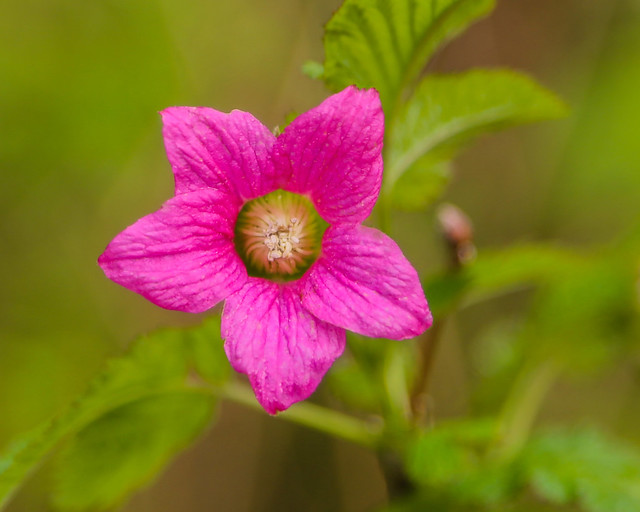
Salmonberry flower at Buntzen Lake
A salmonberry flower at Buntzen Lake. Berry-producing shrubs are an important natural food source for bears.

What to Do if You Encounter a Bear

Every bear encounter is different, and the bear’s behaviour matters. In general, if a bear becomes aware of you but is not approaching aggressively, remain calm, speak in a low voice, and slowly increase the distance between you and the bear.

  • Do not run. Running can trigger a chase response.
  • Do not approach. Give the bear plenty of room and allow it to leave.
  • Do not stare directly at the bear. Keep the bear in sight, but avoid prolonged direct eye contact, especially if it appears agitated or defensive.
  • Back away slowly. Avoid sudden movements.
  • Have bear spray ready. It should be carried somewhere immediately accessible, not buried inside a backpack.
  • If a bear bluff charges: stand your ground, prepare your bear spray, and do not run.

A bear that stomps, woofs, jaw-pops, or bluff charges may be telling you that you are too close. Increase your distance calmly and give it space.

Carry Bear Spray

Bear spray can be an effective deterrent, but only if it is accessible and you know how to use it. Carry it in a holster or another location where you can reach it immediately rather than storing it inside your backpack.

Check the expiry date, practise removing the safety clip before heading out, and learn the correct technique before you need it. Bear spray is emergency equipment, not something to experiment with on the trail.

Never Feed Bears

Never intentionally feed a bear or leave food where wildlife can access it. Food-conditioned bears can lose their natural wariness of people, increasing the risk of conflict for both the bear and visitors.

Pack out food scraps and other garbage, including fruit peels and cores. Even biodegradable food waste can attract wildlife to trails and recreation areas.

Bear Photos from Deboville Slough

The two bear photographs below were not taken at Buntzen Lake. I photographed these black bears at Deboville Slough in northeast Coquitlam in 2013 while they were feeding on berries.

They appeared much more interested in their natural food than in me, but photographs like these should always be taken from a safe distance. A bear that appears relaxed can still react quickly if approached or disturbed.
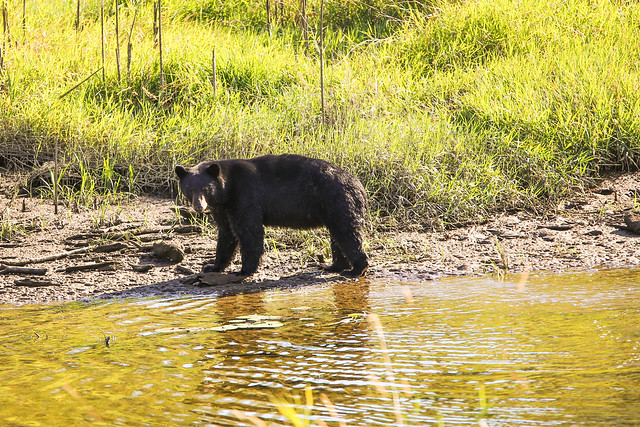
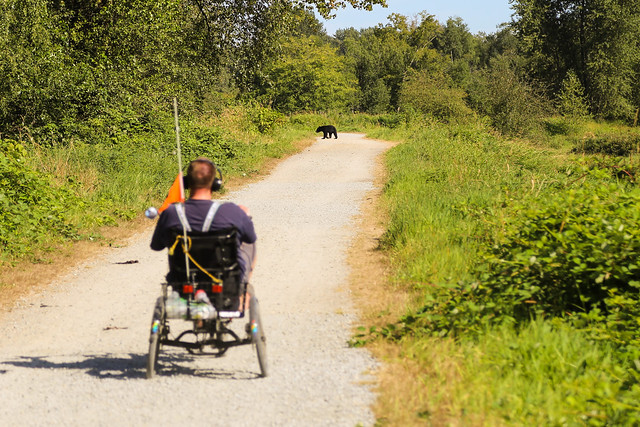
Black bear at Deboville Slough in Coquitlam
A black bear at Deboville Slough in Coquitlam. This photograph was not taken at Buntzen Lake.
Black bear feeding near Deboville Slough in Coquitlam
Another black bear at Deboville Slough. Always photograph wildlife from a safe distance.

Dogs and Bears

Dogs can complicate bear encounters. A dog may chase or provoke a bear and then run back toward its owner. Keep dogs under control and follow posted leash requirements, particularly where bears or other wildlife have recently been reported.

Report Problem Bears

A bear simply moving through the forest does not normally require intervention. However, aggressive behaviour, bears repeatedly accessing human food, or other serious wildlife conflicts should be reported to the BC Conservation Officer Service at 1-877-952-7277.

Learn More About Bear Safety

For current information about bear behaviour, avoiding encounters, bear spray, and what to do during an encounter, visit WildSafeBC’s black bear safety information.

BC Hydro also reminds visitors to its recreation areas that wildlife, including bears and cougars, may be encountered and that wildlife should never be fed.

Bear behaviour is unpredictable, and no set of guidelines can guarantee a safe encounter. Give wildlife plenty of space, follow current posted warnings, carry bear spray where appropriate, and use current bear-safety guidance before heading into bear country.
Interesting Nature

Interesting Trees Around Buntzen Lake

After hundreds of walks and hikes around Buntzen Lake, I have come across plenty of unusual trees, roots, stumps, and other small details that are easy to miss if you are focused only on reaching your destination.

Some are the result of natural growth, decay, fire, or injury. Others are reminders of the area’s logging history. This page is a collection of some of the more interesting examples I have photographed around Buntzen Lake and the surrounding trails.

A Tree with a Major Sap Flow

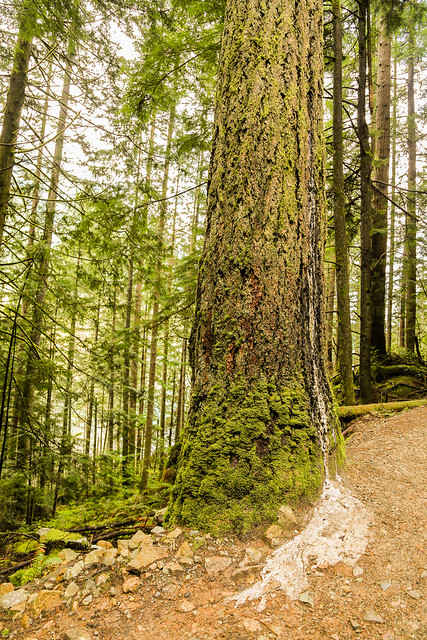
This tree on the west side of the Buntzen Lake Trail was producing an unusually large amount of sap or resin. The flow started well above ground level and had built up into a thick layer extending downhill for roughly 2 m.

Trees can produce sap or resin in response to injury, insect activity, disease, cracks in the bark, or other stress. Without examining the tree closely, it is impossible to know exactly what caused this particular flow, but it was certainly one of the more dramatic examples I have seen.

Tree with a large sap or resin flow beside the Buntzen Lake Trail
A large sap or resin flow on a tree beside the Buntzen Lake Trail.

A Burned Spiral Tree

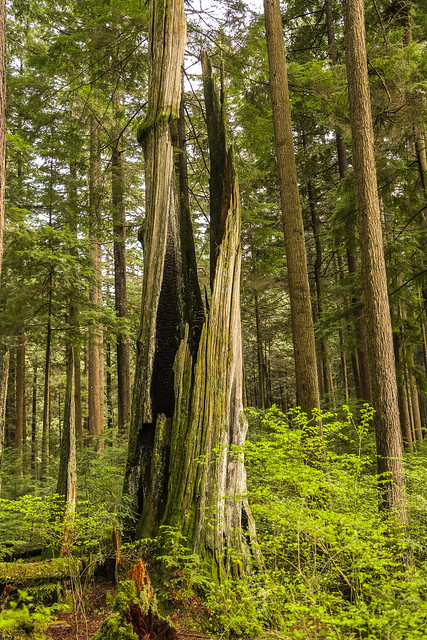
On the east side of Buntzen Lake, I found this burned-out tree with a striking spiral shape. Fire, decay, wind, and uneven growth can leave trees with some remarkable forms, although the exact history of this one is unknown.

Burned spiral-shaped tree at Buntzen Lake
A burned tree with an unusual spiral form on the east side of Buntzen Lake.

Stumps Growing on Stumps

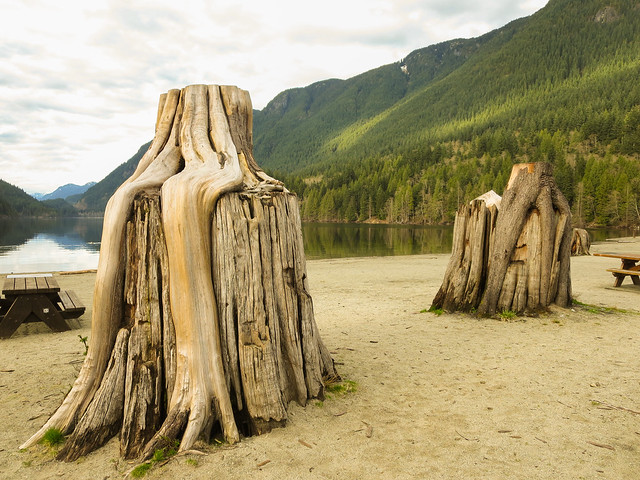
Large old logging stumps are common around Buntzen Lake and are reminders of logging that took place in the area many decades ago.

The stumps below are particularly interesting. New trees established themselves on top of the older stumps, sending roots down around the decaying wood. Those younger trees were later cut as well, leaving what looks like a stump growing on top of another stump.

As old stumps slowly decay, the roots of the younger tree can remain standing around the empty space, sometimes forming surprisingly elaborate shapes.

Trees growing from old logging stumps at Buntzen Lake
Old logging stumps supporting later generations of trees near South Beach.

Woodpecker Excavation

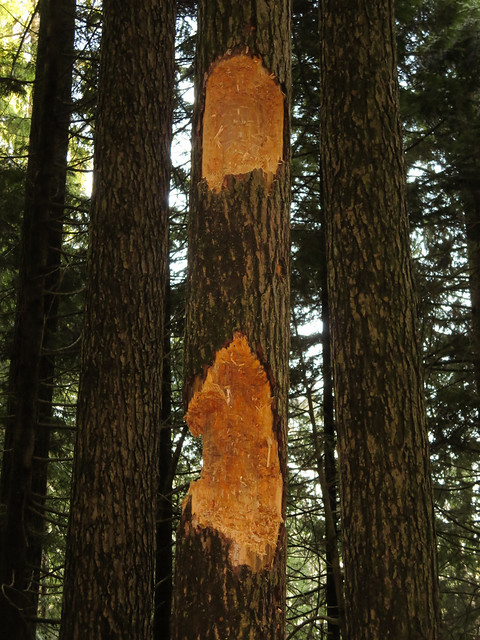
During one walk on Lakeview Trail, I noticed what looked almost like someone had attacked a tree with a saw. The damage was high above the ground and surprisingly extensive.

On a later visit, the mystery was solved when I saw a woodpecker actively working on the tree. By then, it had already begun excavating a second section.

Woodpeckers excavate trees for several reasons, including searching for insects and creating nesting or roosting cavities. Decaying or insect-damaged wood is often particularly attractive to them.

Woodpecker excavation damage high on a tree along Lakeview Trail
Woodpecker excavation high on a tree along Lakeview Trail.

A Tiny Waterfall After Heavy Rain

Heavy rainfall can reveal small features around Buntzen Lake that disappear again once the forest dries out. After one particularly wet period, water was dripping steadily over a moss-covered rock beside the trail, creating what looked like a miniature waterfall.

A Loopy Branch

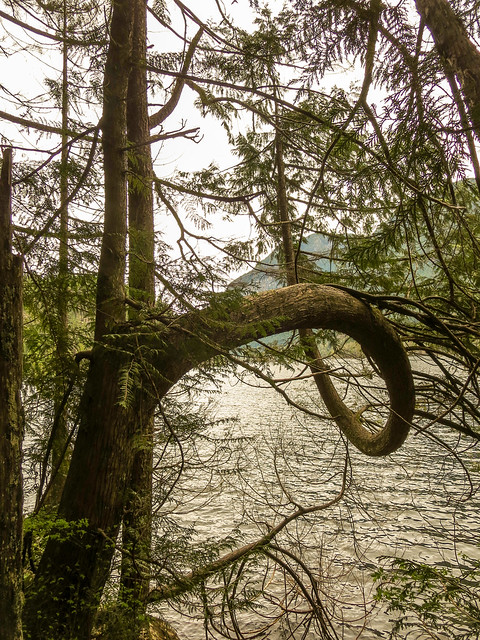
This branch somehow managed to form an almost complete loop before continuing to grow. Trees can produce unusual shapes when branches are redirected by obstacles, damage, changing light conditions, or irregular growth.

Tree branch growing in a loop at Buntzen Lake
A branch with an unusual loop-shaped growth pattern.

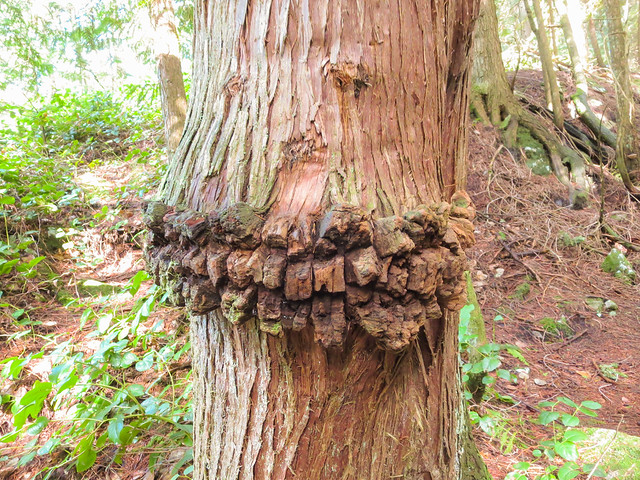
An Unusual Tree on the Diez Vistas Trail

This tree on the Diez Vistas Trail has another unusual growth pattern. It may have been influenced by an old injury, damage when the tree was young, competing growth, or another disturbance, but there is no way to determine the exact cause from appearance alone.

Tree with an unusual growth pattern on the Diez Vistas Trail
An unusual growth pattern on a tree along the Diez Vistas Trail.

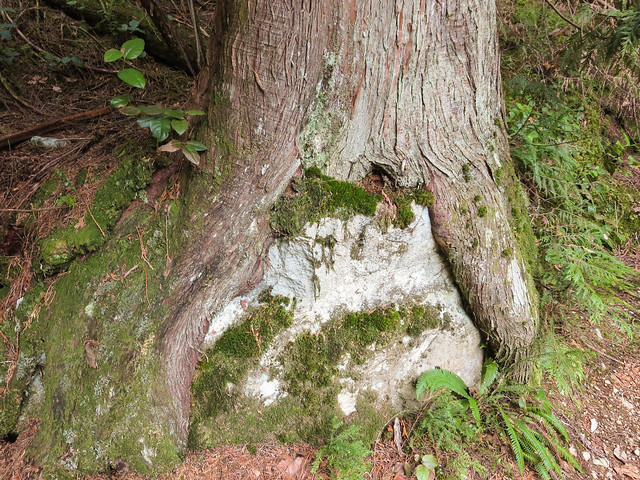
A Tree Growing Around a Rock

Trees are remarkably good at adapting to obstacles. This one began growing beside a large rock and gradually expanded around it.

As trunks and roots increase in diameter, they can slowly envelop rocks, old stumps, fences, and other objects that happen to be in the way.

Tree growing around a large rock near Buntzen Lake
A tree adapting its growth around a large rock.

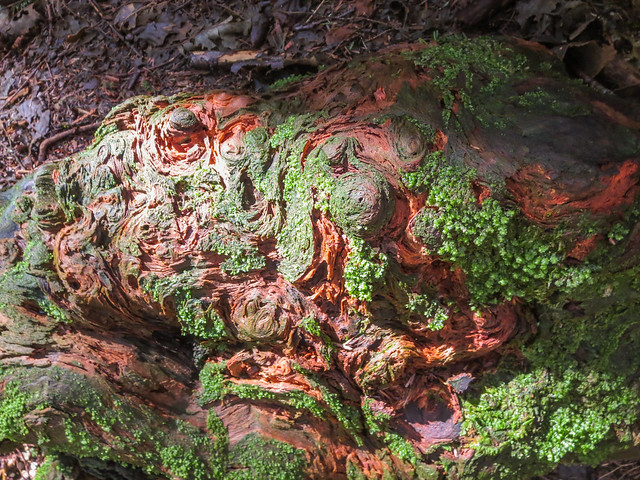
Patterns in the Roots

On a connecting trail between Diez Vistas and Lakeview Trail, I noticed this interesting root pattern. Roots often follow the easiest route through soil, around rocks, and across fallen wood, producing shapes that can look almost deliberately designed.
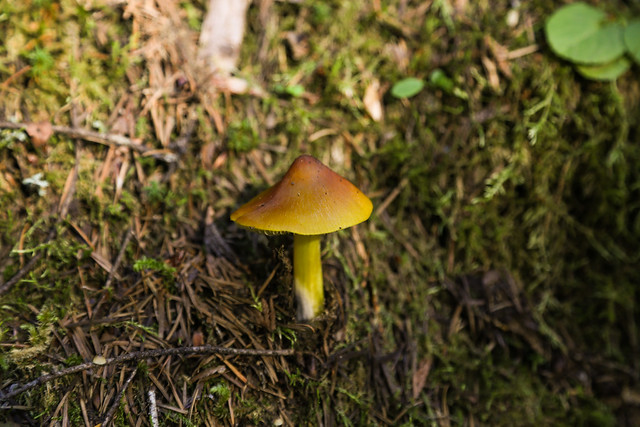
Interesting tree root pattern near Buntzen Lake
An interesting pattern formed by tree roots near Buntzen Lake.

Part of the Fun of Walking at Buntzen Lake

These are the kinds of things I enjoy noticing after repeatedly walking the same trails. A familiar route can look completely different after a storm, during another season, or simply when you happen to notice something you have walked past dozens of times before.

Some of the most interesting features at Buntzen Lake are not viewpoints or destinations at all. They are just small details in the forest that make you stop for a closer look.

Diez Vistas Trail

The Diez Vistas Trail is one of the classic hikes at Buntzen Lake. The name is Spanish for “ten views”, and the route climbs high onto Buntzen Ridge with views toward Indian Arm, Burrard Inlet, Buntzen Lake, Eagle Ridge, and the surrounding mountains.

The hike is considerably more demanding than the Buntzen Lake Loop. Expect a long initial climb, steep switchbacks, rocky and root-covered trail, substantial descents, and several hours in the forest between viewpoints.

Diez Vistas Trail Stats

Distance: approximately 12.4 km for the full loop
Elevation gain: approximately 450 m
Cumulative elevation gain: approximately 720 m
Difficulty: Difficult
Route: Loop
Typical hiking time: approximately 4 to 6 hours
BC Hydro suggested time: 6 to 8 hours
This is not a beginner hike.
Diez Vistas involves sustained climbing, steep switchbacks, long descents, uneven terrain, roots, rocks, and several hours of hiking. You should be comfortable with prolonged uphill hiking and have a reasonable level of fitness before attempting the route.

Hiking time varies considerably depending on fitness, trail conditions, rest stops, and how long you spend at the viewpoints. BC Hydro suggests allowing 6 to 8 hours, which provides a conservative margin for hikers who are unfamiliar with the route. In my experience, the hike can be completed considerably faster. My average time has been about 3 hours 30 minutes, and my fastest time was 2 hours 43 minutes, although both represent a fast pace with relatively limited stopping time. For most hikers, I think allowing approximately 4 to 6 hours is a reasonable starting point.

Fit hikers can complete the full route considerably faster than the official 6-to-8-hour estimate, but I would allow plenty of time if this is your first time on the trail or if you plan to stop at the viewpoints.

Current route information
Trail access around the north end of Buntzen Lake can change because of rockslides, maintenance, and other hazards. BC Hydro currently reports no pedestrian access on Powerhouse Road between North Beach and Buntzen Dam. Hikers completing Diez Vistas should follow the current posted route using the Old Buntzen Lake Trail and other open trails. Check the BC Hydro trail information before heading out.

Diez Vistas GPS Map

The interactive map below shows one of my actual GPS recordings of the Diez Vistas route. Use the layer control in the upper-right corner to switch between the regular map and satellite imagery.

Which Direction Should You Hike?

I strongly prefer hiking Diez Vistas clockwise, beginning near the southwest end of Buntzen Lake. This puts the hardest sustained climb near the beginning of the hike, when you have the most energy, and leaves the easier return toward South Beach for later.

The first part of the route climbs steadily through the forest. After crossing beneath the powerlines and pipeline, the trail reaches a series of switchbacks. This is one of the steepest sustained sections of the hike.

The First Viewpoint

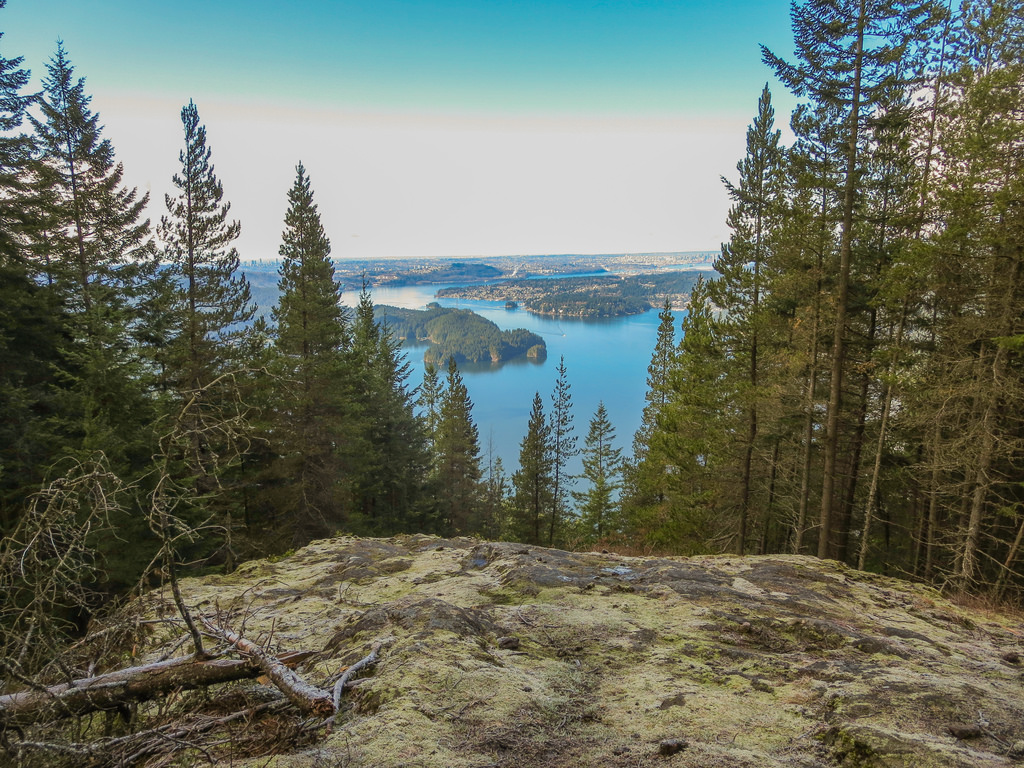
After the initial climb, the first substantial opening provides a welcome reward. This viewpoint was not one of the original numbered Diez Vistas, but it offers an excellent view toward Burrard Inlet and Indian Arm.
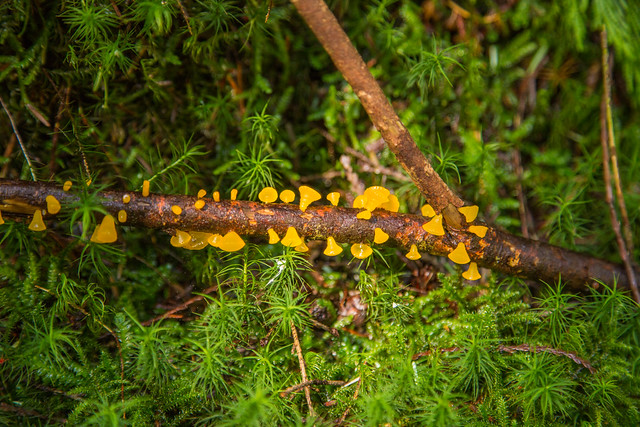
First viewpoint on the Diez Vistas Trail

The first major viewpoint reached when hiking Diez Vistas clockwise.

The East Point Option

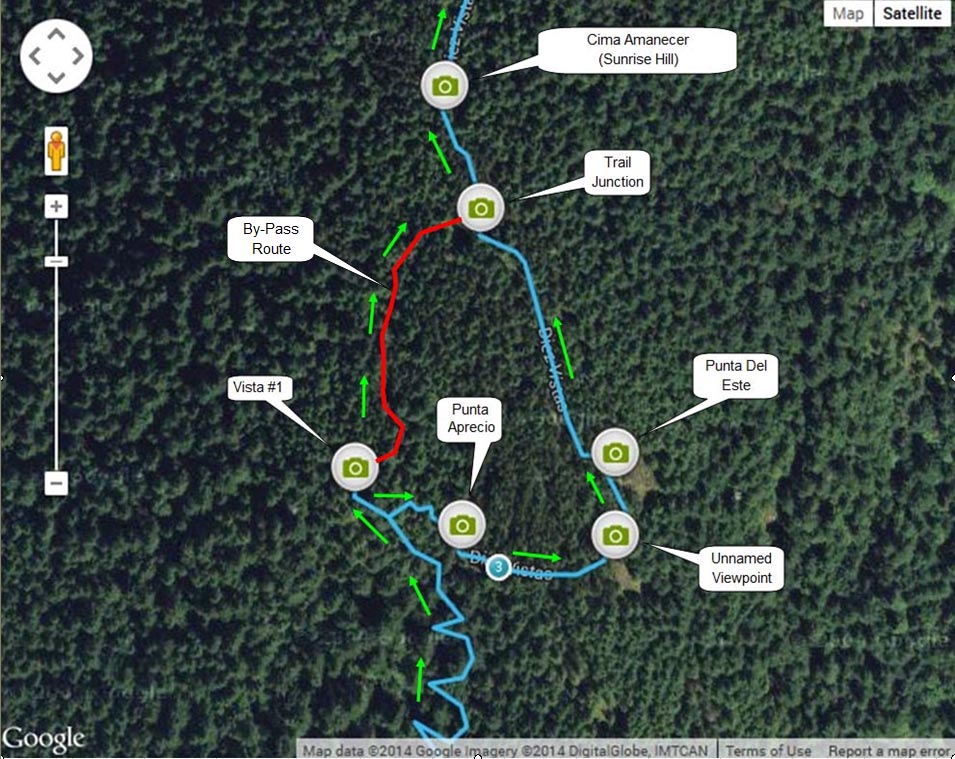
Near this area, hikers have historically had the option of continuing around the East Point side route or following the more direct bypass.

The East Point route includes Punta Aprecio, an unnamed viewpoint, and Punta del Este, with additional views toward Buntzen Lake and Eagle Ridge.

The exact trail junction and signage can change, so follow current trail markers rather than relying exclusively on older maps or descriptions.

Historic map showing the East Point option on Diez Vistas

My older map showing the East Point route and bypass. Follow current onsite signage.

Confused by the “ten views”?
Several of the original vistas have become partly obscured by tree growth, while other excellent viewpoints were never part of the original numbering. See my Diez Vistas: Finding Ten Great Views article for the viewpoint history, East Point details, and my alternate vista maps.

My Favourite Diez Vistas View

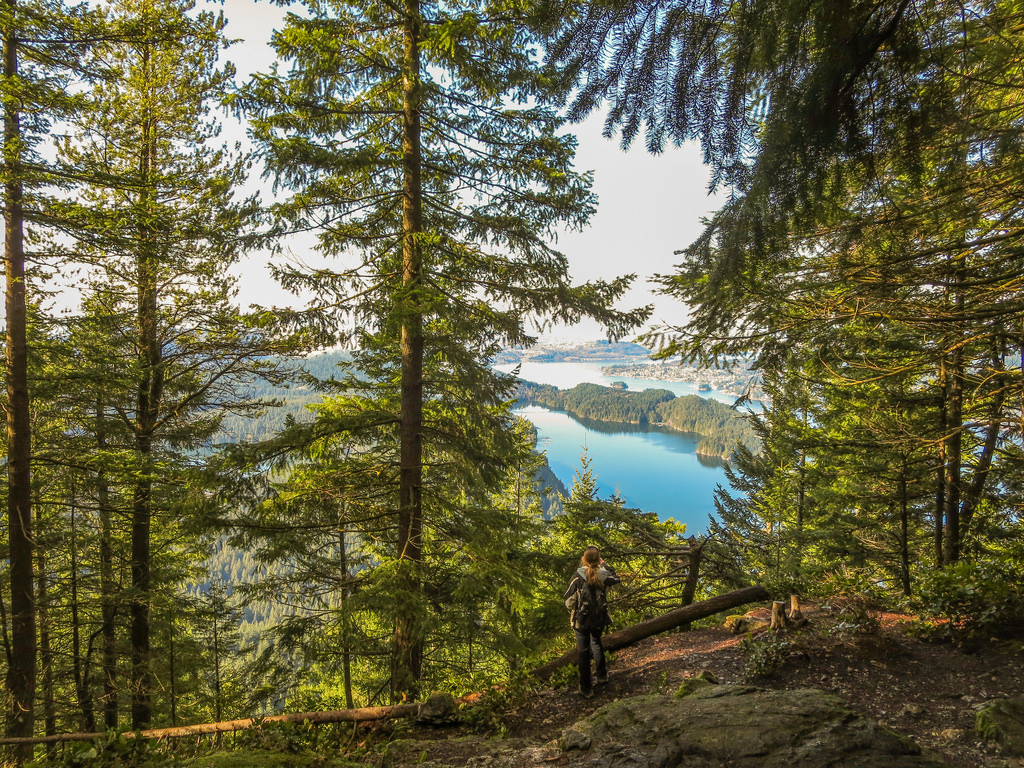
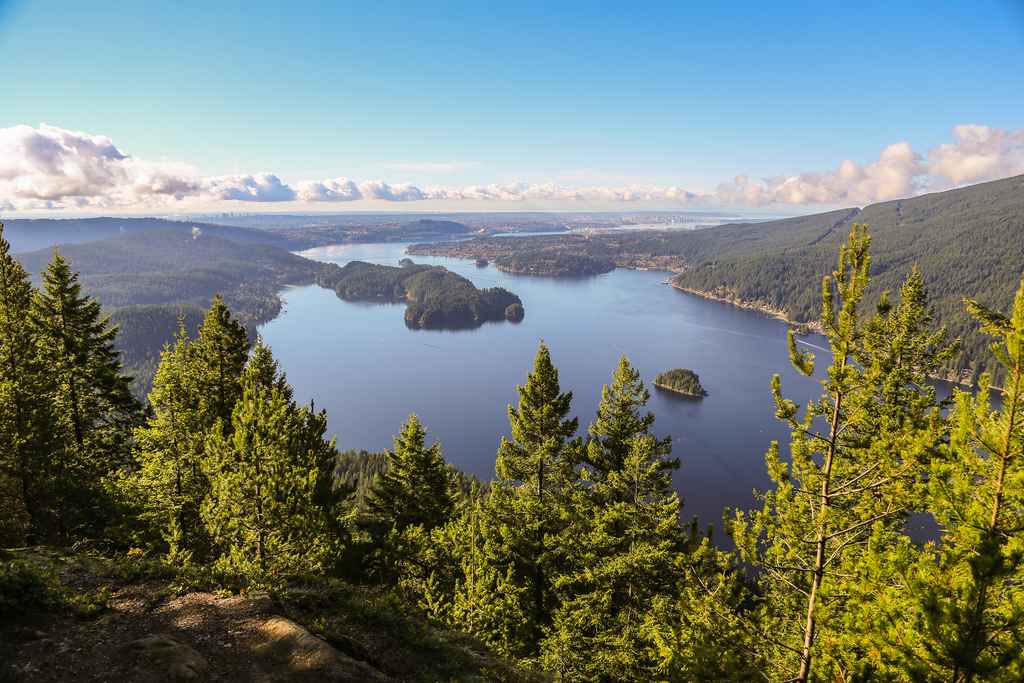
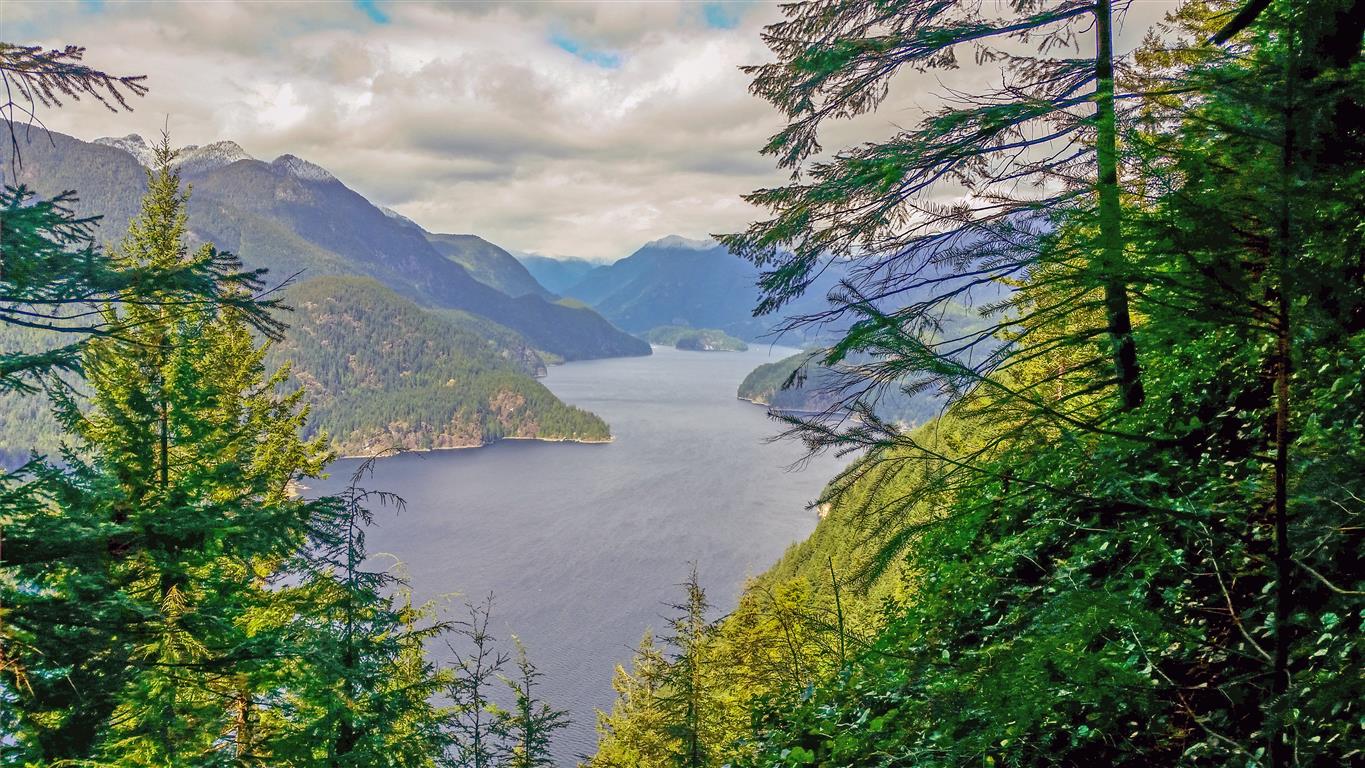
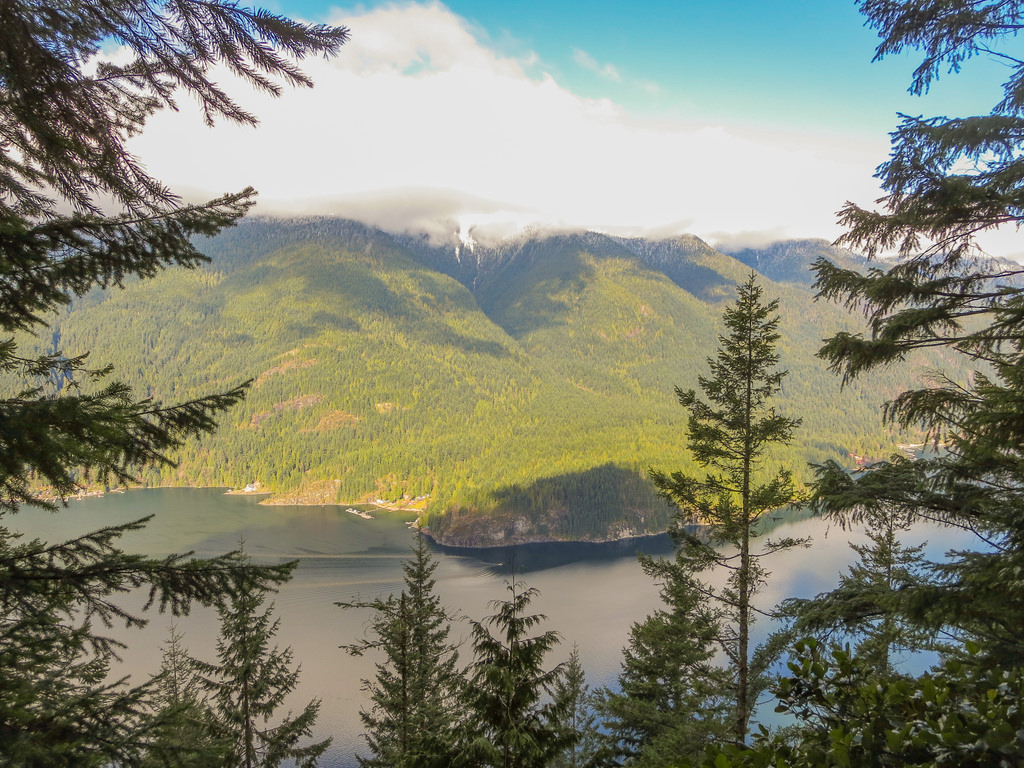
About another kilometre beyond the southern junction is one of the major west-facing viewpoints. This has long been my favourite view on the hike, looking across the southern part of Indian Arm toward Bedwell Bay and the surrounding mountains.

View of Indian Arm from the Diez Vistas Trail

One of my favourite views from Diez Vistas, looking toward Indian Arm.

Above the Clouds

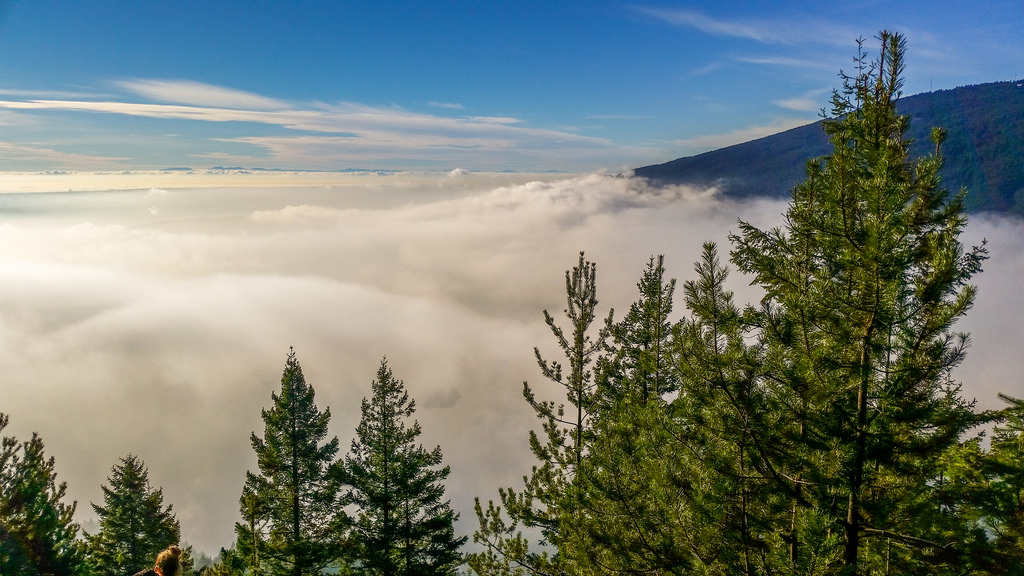
Weather can completely change the character of the viewpoints. On some days, low cloud and fog obscure almost everything. On other days, the ridge can rise above a layer of low cloud, producing views like this:

Above the clouds on the Diez Vistas Trail

Above the low clouds on Buntzen Ridge.

A Popular Trail

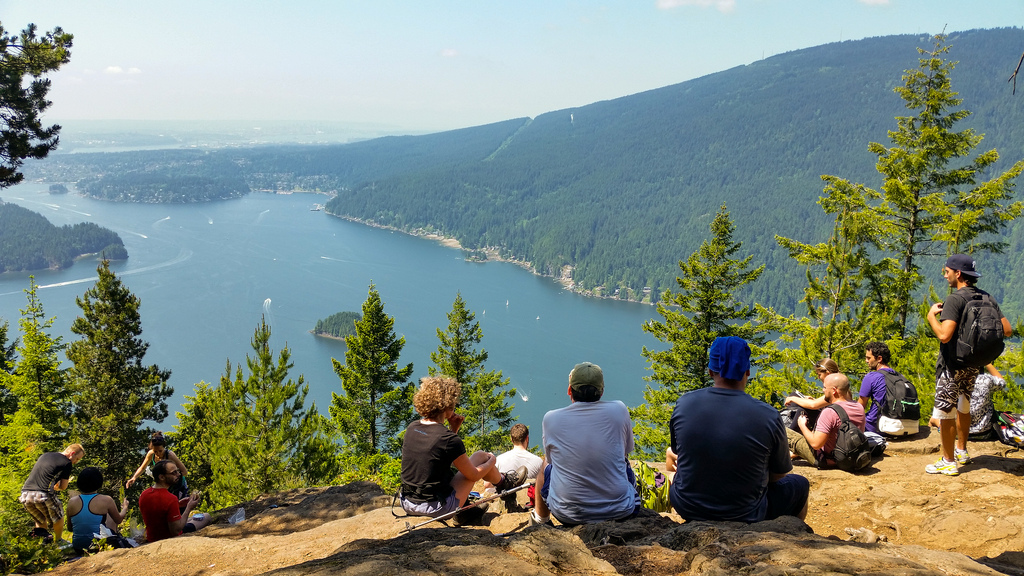
Diez Vistas can be very busy on good-weather weekends, particularly at the major viewpoints where hikers tend to stop for a break.

Hikers gathered at a Diez Vistas viewpoint

A busy viewpoint on a good-weather day.

Views Along the Ridge

The trail continues north along Buntzen Ridge, alternating between forest and viewpoints. Some openings provide broad views, while others have become increasingly screened by trees.

One of the northern viewpoints looks along Indian Arm:

View north along Indian Arm from Diez Vistas

Looking north along Indian Arm from Buntzen Ridge.

What Is the Trail Like?

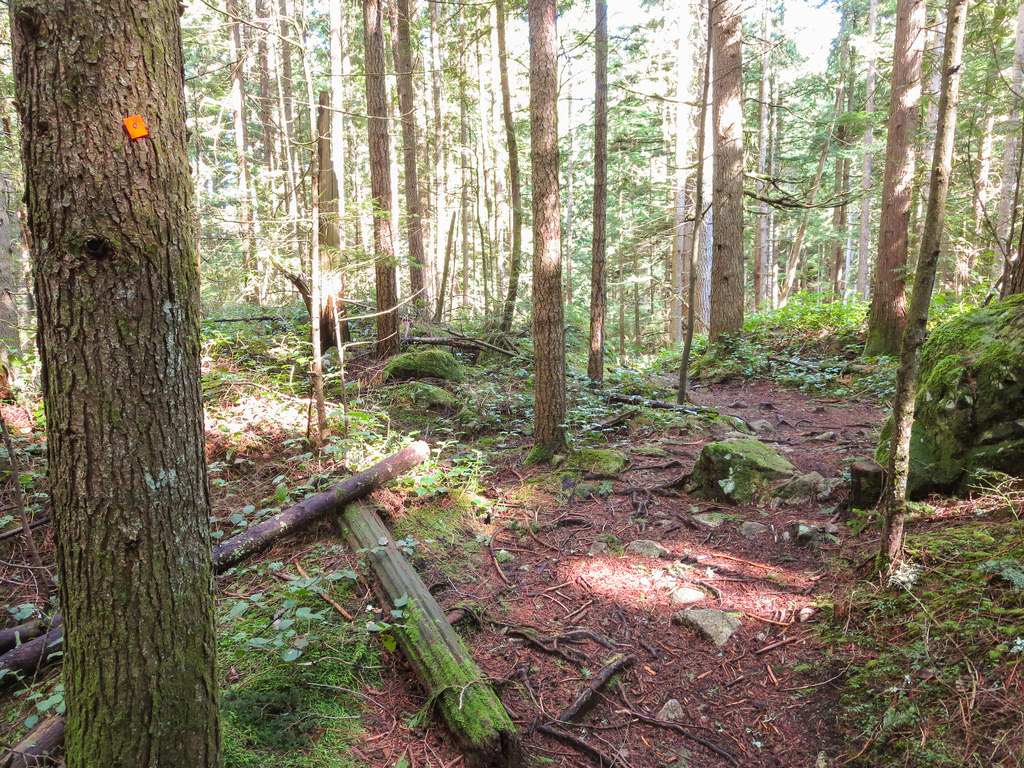
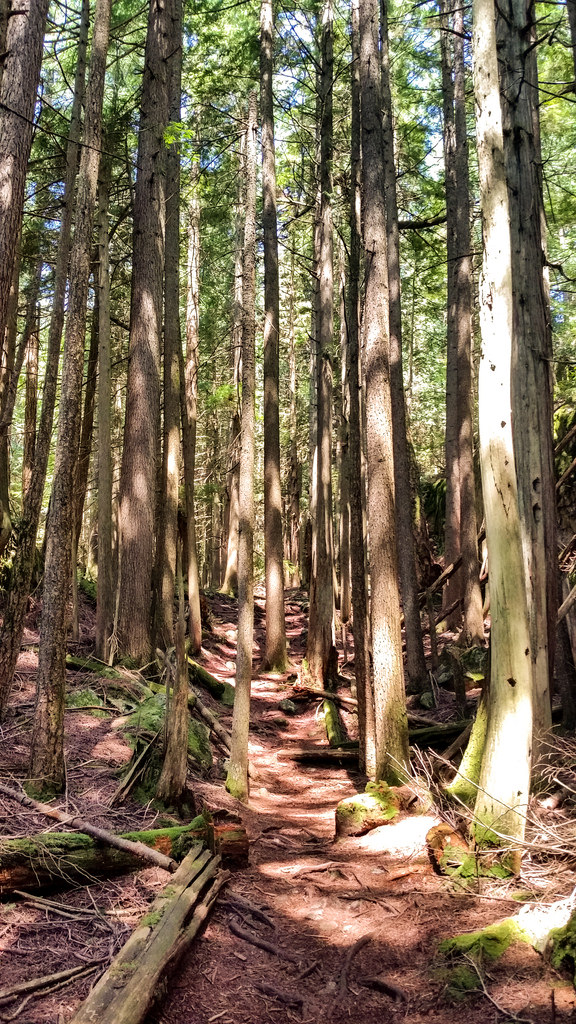
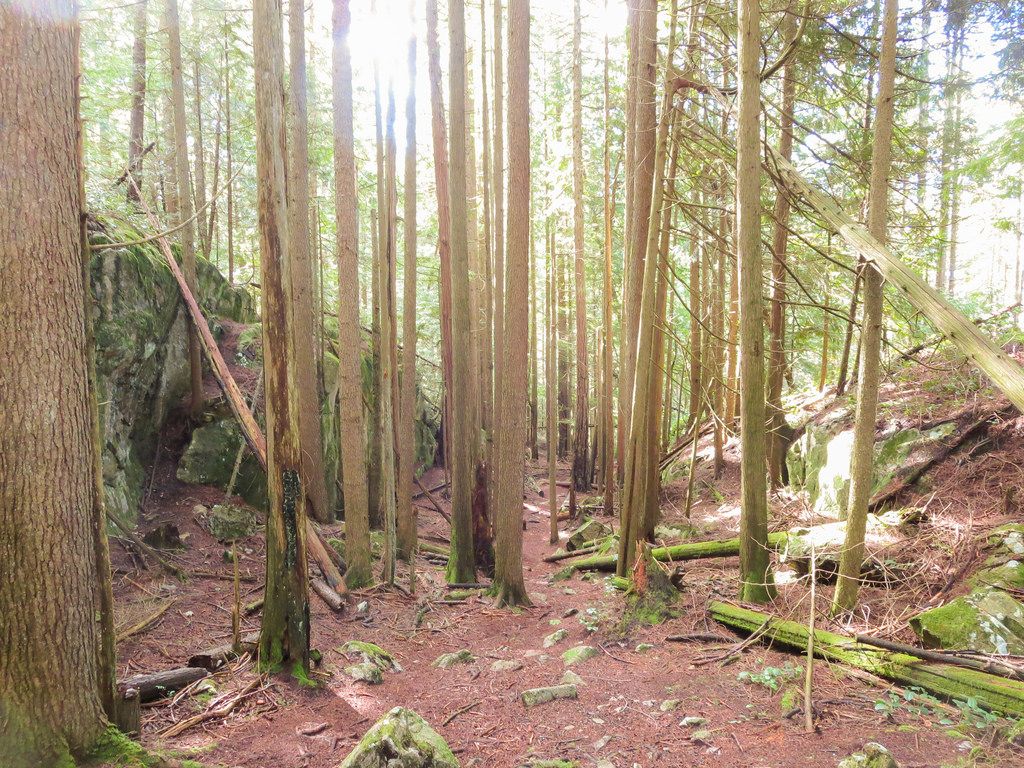
Much of Diez Vistas is a forest hike. Between the viewpoints, expect roots, rocks, uneven ground, short climbs and descents, and some steeper sections.

Forested section of the Diez Vistas Trail

A typical forested section of the Diez Vistas Trail.

Rocky forest trail on Diez Vistas

Another section of trail along Buntzen Ridge.

Diez Vistas Trail through the forest

Forest trail on Diez Vistas.

Some Vistas Change Over Time

The name may promise ten views, but the forest does not remain static. Some original vistas that were once open have become increasingly obstructed as trees and other vegetation have grown.

Partially obstructed viewpoint on the Diez Vistas Trail

One of the viewpoints along the ridge.

View through the trees from Diez Vistas

Another Diez Vistas viewpoint where vegetation affects the view.

The Northern Descent

Eventually the ridge walking gives way to a substantial descent through the forest. After the first major descent, the trail reaches wider sections that resemble old forestry or service roads before continuing toward BC Hydro infrastructure at the north end of the route.

Follow the current trail markers carefully through this area. The route and available connections can change because of maintenance, rockslides, vegetation, and other conditions.

Old Buntzen Lake Trail and Swan Falls

The northern part of the route connects with the Old Buntzen Lake Trail, which passes near McCombe Lake before eventually reconnecting with trails leading back toward Buntzen Lake.

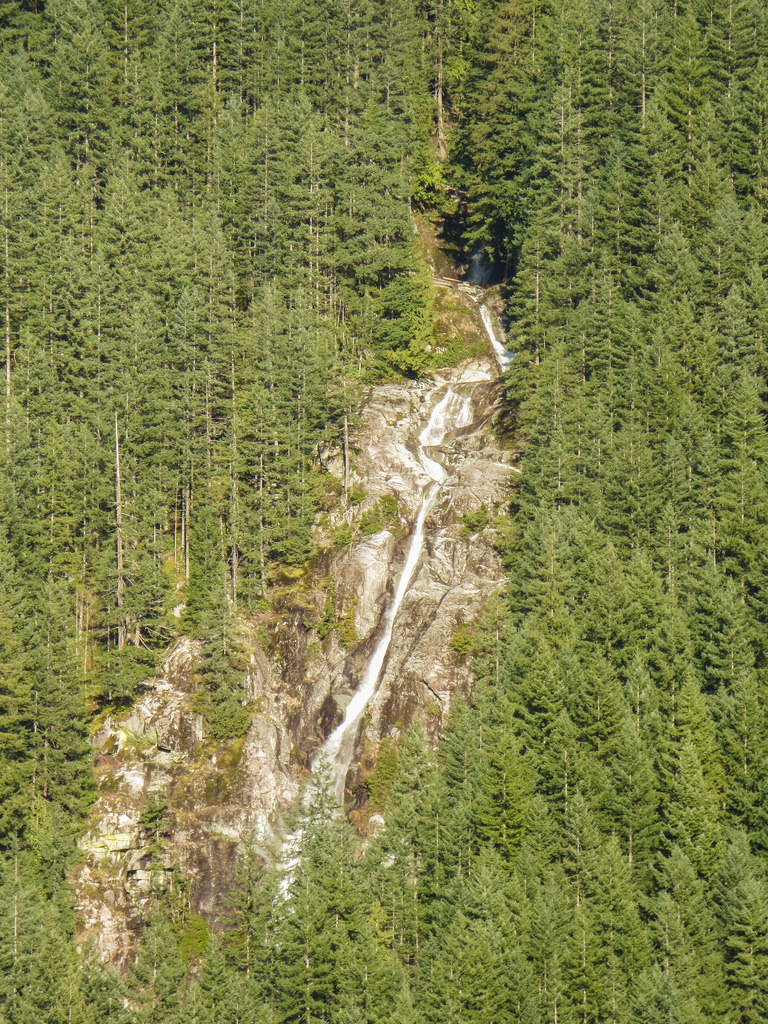
This area also provides access to several seasonal waterfalls on the steep slopes above the lake, including Swan Falls.

Swan Falls near the Diez Vistas route

Swan Falls near the north end of the Diez Vistas route.

Returning to South Beach

The route eventually reconnects with the Buntzen Lake trail system for the return toward South Beach. The final portion is much easier than the initial climb onto Buntzen Ridge, which is another reason I prefer doing the hike clockwise.

Because trail connections around North Beach and Powerhouse Road can change, follow current BC Hydro signage rather than relying solely on an older route description.

Before You Go

Diez Vistas is a substantial day hike. Bring suitable footwear, adequate water and food, a fully charged phone, and enough time to complete the route before the Buntzen Lake gate closes. Cell coverage can be unreliable in parts of the area, so downloading an offline map before starting is useful.

Dogs are permitted on the trails but must be leashed except in designated off-leash areas.

If you are driving during the seasonal reservation period, check the current Buntzen Lake parking information before leaving home.

For the full story behind the trail’s confusing viewpoint numbering, see my Diez Vistas: Finding Ten Great Views article.

Trail conditions, viewpoints, closures, and access can change due to weather, vegetation, maintenance, and other factors. Before heading out, check BC Hydro for current trail closures and major access advisories.

Buntzen Lake Pipeline

The Old Buntzen Lake Pipeline: Photos and History

While hiking around Buntzen Lake, you may have noticed sections of an old metal pipeline running through the forest. I’ve come across it many times over the years, particularly near the pumphouse at the southern end of the lake and along the lower section of the Diez Vistas Trail.

It might look like an abandoned piece of industrial infrastructure, but this pipeline has an interesting history. It once carried freshwater from Buntzen Lake to the Burrard Thermal Generating Station in Port Moody, approximately 6 km to the south.

During my hikes, I’ve photographed several sections of the old pipeline, including its joints, fittings, and some rather unusual structures.

What Was the Buntzen Lake Pipeline Used For?

The pipeline supplied freshwater to the Burrard Thermal Generating Station, a natural gas-fired power plant on the shores of Burrard Inlet in Port Moody.

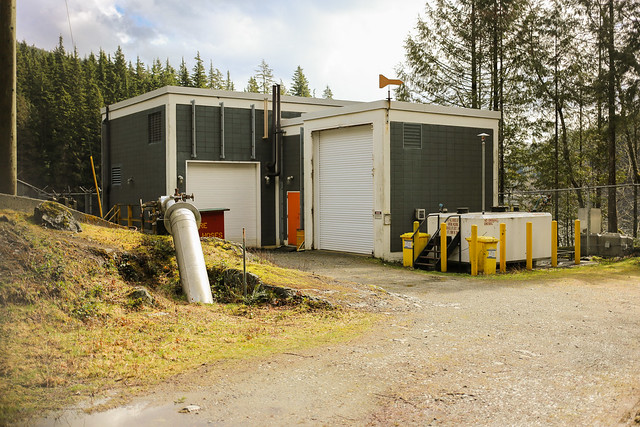
The pumphouse at Buntzen Lake, shown below, was part of the system that delivered water to the generating station.

Buntzen Lake pumphouse associated with the freshwater pipeline to Burrard Thermal Generating Station

The Buntzen Lake pumphouse, photographed during one of my visits.

The freshwater supply served several important purposes at Burrard Thermal, including:

  • Boiler make-up water for steam generation.
  • Fire protection.
  • Domestic and potable water supply.
  • Other plant cooling and utility services.

Boiler make-up water was particularly important. Burrard Thermal burned natural gas to produce steam, which drove turbines connected to electrical generators. Water lost from the steam system had to be replaced with treated freshwater.

The plant also used seawater from Burrard Inlet for major cooling operations. The freshwater pipeline from Buntzen Lake served a different purpose from the large saltwater cooling system.

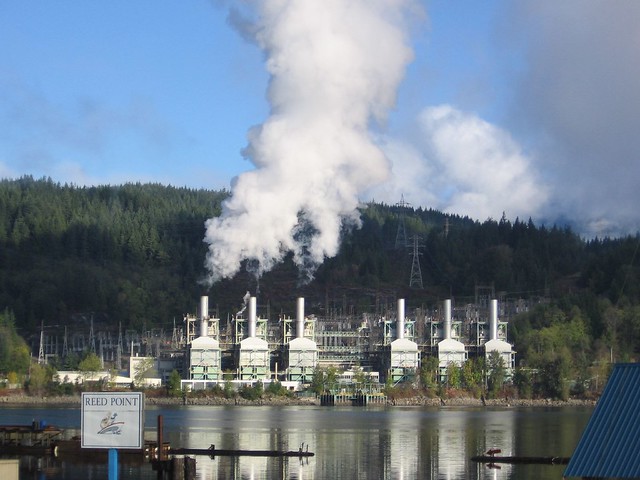
Below is one of my photographs of the Burrard Thermal Generating Station.

Burrard Thermal Generating Station on Burrard Inlet in Port Moody before electricity generation ceased in 2016

Burrard Thermal Generating Station in Port Moody.

The Original Above-Ground Pipeline

According to my original research, the old pipeline had a diameter of approximately 20 cm (8 inches). It was subsequently replaced by a larger underground pipeline with a nominal diameter of 30 cm (12 inches).

Interestingly, increasing the pipe diameter from 20 cm to 30 cm provides approximately 2.25 times the cross-sectional area. That is a substantial increase in potential water-carrying capacity, although the actual flow also depends on factors such as pumping pressure, pipe length, and friction losses.

The old pipeline followed portions of the forested terrain around the southern end of Buntzen Lake. Some sections were above ground, making them easy to recognize.

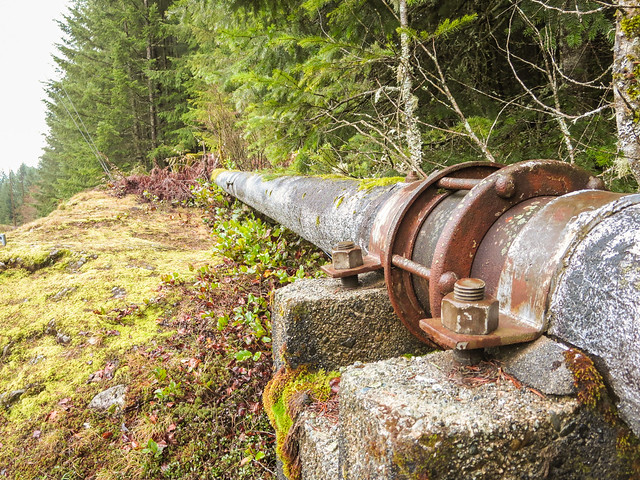
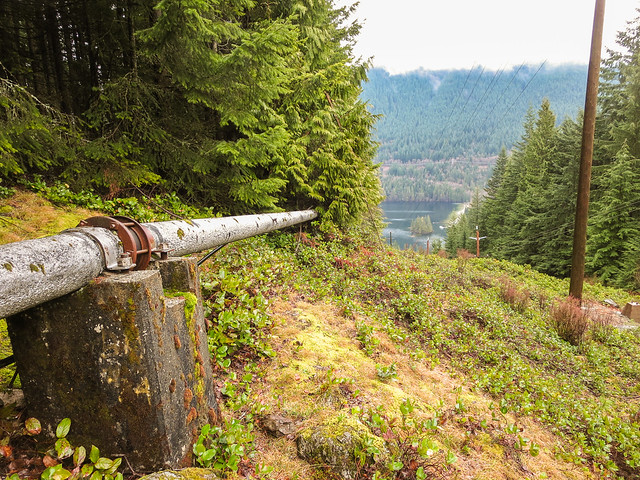
Here are two photographs of the old pipeline that I took while exploring the area.

Old exposed freshwater pipeline running through the forest near Buntzen Lake

A section of the original above-ground pipeline.

Another section of the former Buntzen Lake freshwater pipeline showing its exposed metal construction

Another view of the old pipeline.

The Pipeline on the Diez Vistas Trail

One of the more noticeable sections of the old pipeline was on the lower portion of the Diez Vistas Trail, where the route climbs through the forest on the western side of Buntzen Lake.

BC Hydro’s historical trail descriptions specifically mention hikers crossing the powerline corridor and pipeline before beginning the steep switchbacks.

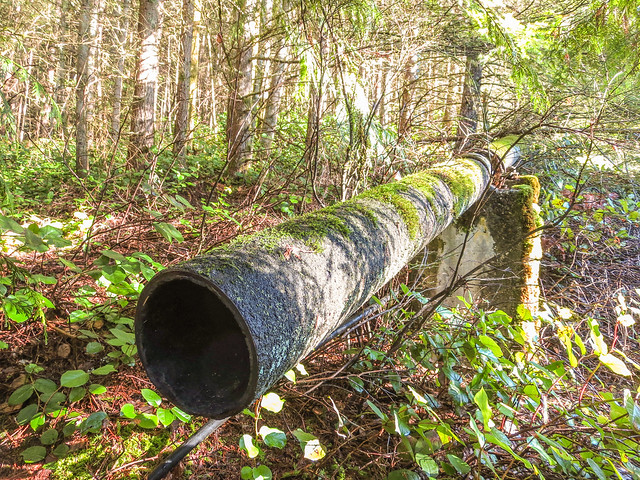
In the photograph below, you can see where a section of the old pipeline was removed to provide clearance for the trail. Fortunately, that meant we didn’t have to do the limbo every time we hiked past it!

Discontinued Buntzen Lake pipeline with a section removed to provide clearance along the Diez Vistas Trail

The old pipeline where it crossed the Diez Vistas Trail.

Some Interesting Pipeline Features

During my explorations, I also came across some unusual features of the old pipeline.

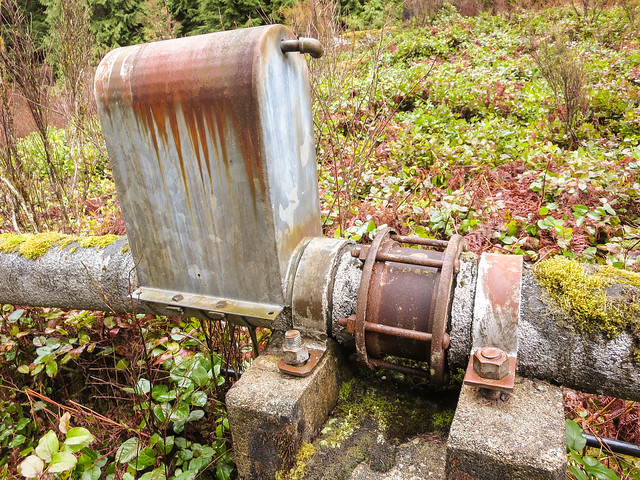
An Unusual Apparatus

The photograph below shows an interesting metal apparatus attached to the pipeline. I’m not certain what its function was, but fittings like these can form part of a pipeline’s flow-control, pressure-management, or maintenance systems.

Without engineering drawings or identifying markings, I wouldn’t want to guess exactly what this particular piece of equipment did.

Unidentified mechanical apparatus attached to the old Buntzen Lake freshwater pipeline

An unusual piece of equipment attached to the old pipeline.

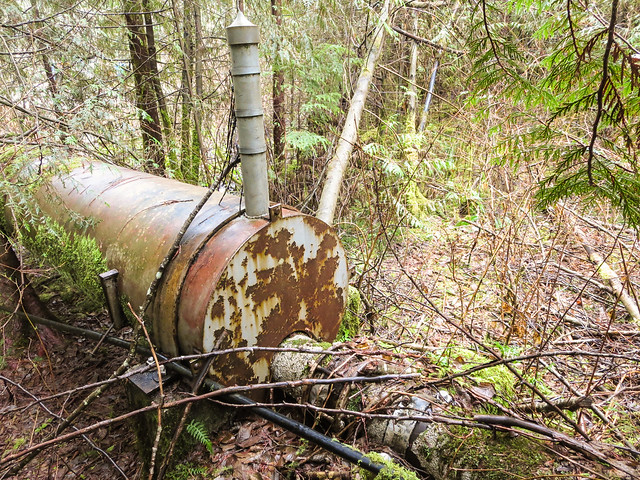
A Much Larger Cylindrical Structure

Near the pumphouse, I found something even more intriguing. The smaller pipeline appears to emerge from a much larger cylindrical metal structure.

In my original notes, I recorded the larger section as approximately 75 cm (30 inches) in diameter and 25 m long.

At the time, I wondered whether it had something to do with preventing water from flowing backwards. However, I have never confirmed its actual purpose.

It could have served a protective or other engineering function, but identifying it properly would require historical plans or information from someone familiar with the original water supply system.

Old Buntzen Lake pipeline emerging from a much larger cylindrical metal structure near the pumphouse

The old pipeline emerging from a larger cylindrical structure near the pumphouse.

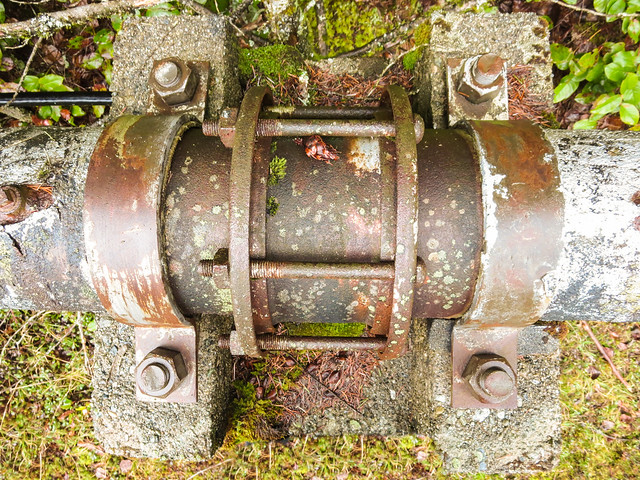
Pipeline Couplings

One of my favourite detail photographs shows the metal clamps connecting sections of the pipeline.

These mechanical couplings help join individual pipe sections. Depending on their design, they can also facilitate maintenance and accommodate small amounts of movement.

Close-up of metal coupling clamps connecting sections of the old Buntzen Lake pipeline

A closer look at the pipeline’s coupling clamps.

What Happened to Burrard Thermal Generating Station?

When I originally published this article in December 2013, Burrard Thermal was still operating, although the provincial government had already announced plans to end electricity generation by 2016.

That closure did take place in 2016.

According to BC Hydro, Burrard Thermal was built in 1960 and had an installed generating capacity of approximately 950 megawatts. It was one of the largest natural gas-fired generating stations in British Columbia.

Although electricity generation ended in 2016, the facility did not simply shut down completely. Some of its electrical equipment continued providing voltage support to the Lower Mainland transmission system.

A Major Update in 2026

On 27 January 2026, BC Hydro presented plans to Port Moody City Council for the eventual dismantling and remediation of much of the former generating station.

The proposed work includes removing major generating equipment, boilers, buildings, and parts of the marine cooling-water infrastructure.

Under the schedule presented in January 2026, major decommissioning work was expected to begin in 2028, with dismantling and restoration continuing into the 2030s, subject to regulatory approvals.

However, there was one particularly interesting detail for this article: BC Hydro indicated that the freshwater supply system from Buntzen Lake would be retained.

In other words, although the original above-ground pipeline was replaced long ago and the generating station no longer produces electricity, the connection between Buntzen Lake and the former Burrard Thermal property remains part of BC Hydro’s infrastructure plans.

For more information about the proposed dismantling, see the February 2026 report by Tri-Cities Dispatch.

Not to Be Confused With the Buntzen Hydroelectric Penstocks

Buntzen Lake has another, much older connection to electricity generation.

Long before Burrard Thermal was constructed, water from Buntzen Lake was being used to generate hydroelectricity at the northern end of the lake.

The original Buntzen No. 1 Powerhouse began operating in 1904, and Buntzen No. 2 followed in 1914. Large pipes known as penstocks carried water downhill from the lake to the generating stations beside Indian Arm.

These penstocks are entirely different from the smaller freshwater pipeline shown in my photographs.

The distinction is interesting:

  • The Burrard Thermal pipeline: Used pumps to transport freshwater south from Buntzen Lake to the natural gas-fired generating station in Port Moody.
  • The Buntzen hydroelectric penstocks: Carry water from the northern end of Buntzen Lake downhill to hydroelectric generating equipment beside Indian Arm, using the pressure created by the elevation difference.

Both systems are part of the industrial history of Buntzen Lake, but they were designed for very different purposes.

For more about the early hydroelectric developments, see my article on the history of Buntzen Lake.

Interesting Facts

  • The pipeline supplied a natural gas-fired power plant. Unlike the hydroelectric stations at the northern end of Buntzen Lake, Burrard Thermal generated electricity by burning natural gas to produce steam.
  • Freshwater and seawater served different purposes. Freshwater from Buntzen Lake was used for boiler make-up and other plant services, while seawater from Burrard Inlet was used in the plant’s major cooling system.
  • The replacement pipeline was substantially larger. Based on the nominal diameters recorded in my original article, increasing the diameter from 20 cm to 30 cm provided approximately 2.25 times the cross-sectional area.
  • The original exposed pipeline became part of the hiking landscape. Historical trail descriptions refer to the Diez Vistas Trail crossing the pipeline before the steep climb up Buntzen Ridge.
  • Burrard Thermal stopped generating electricity in 2016. However, electrical equipment at the property continued providing voltage support to the Lower Mainland transmission system.
  • The freshwater supply system is being retained. During BC Hydro’s January 2026 presentation on the planned dismantling of Burrard Thermal, the freshwater supply system from Buntzen Lake was identified as infrastructure that would remain.
  • Buntzen Lake has supplied two very different types of generating stations. Its water has supported both hydroelectric generation at Indian Arm and the former natural gas-fired Burrard Thermal plant in Port Moody.

A Reminder of Buntzen Lake’s Industrial Past

Most people visit Buntzen Lake for the beaches, forests, and hiking trails, but there is a tremendous amount of industrial history hidden among the trees.

Old pipelines, hydroelectric equipment, abandoned foundations, transmission structures, and other remnants are reminders that the area has been used for electricity generation for more than a century.

I’ve photographed several other examples in my article on industrial decay around Buntzen Lake.

The photographs in this article were taken during my earlier explorations. Pipeline sections and other structures may have been removed, modified, or become inaccessible since then. Please respect posted signs, remain on designated trails, and stay clear of restricted utility infrastructure.

It’s fascinating to think that something as ordinary as a rusty old pipe in the forest once helped support one of the largest generating stations in British Columbia.

Mushrooms and Fungi Around Buntzen Lake

The forests around Buntzen Lake provide excellent growing conditions for an amazing variety of mushrooms and other fungi. With all the rain, damp forest floors, moss-covered logs, and decaying trees, there’s no shortage of places to find something interesting.

I’m a fun guy, but I’m certainly not a fungi expert! Over the years, I’ve photographed all sorts of mushrooms while hiking the trails around Buntzen Lake, particularly on the Diez Vistas and Lakeview trails.

October and November are especially good months for mushroom photography, when autumn rains encourage many species to produce their fruiting bodies. However, fungi can be found throughout the year, and some of the most interesting ones are easy to overlook.

Below are some of my mushroom photographs. I haven’t attempted to identify every species, so if you’re knowledgeable about fungi and recognize any of them, feel free to leave a comment!

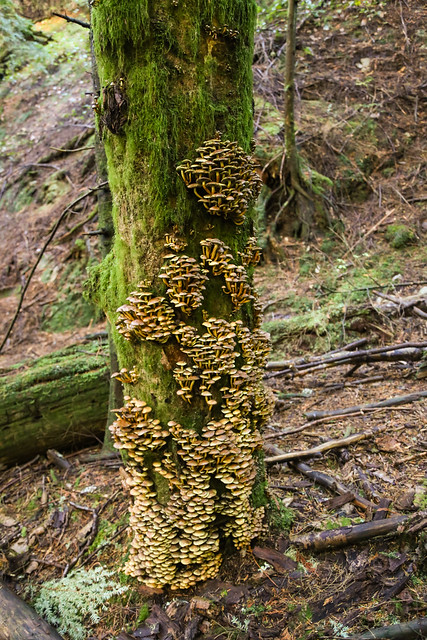
Mushrooms Growing on Trees

Some of the most impressive fungi I’ve encountered have been growing directly out of tree trunks, logs, and old stumps.

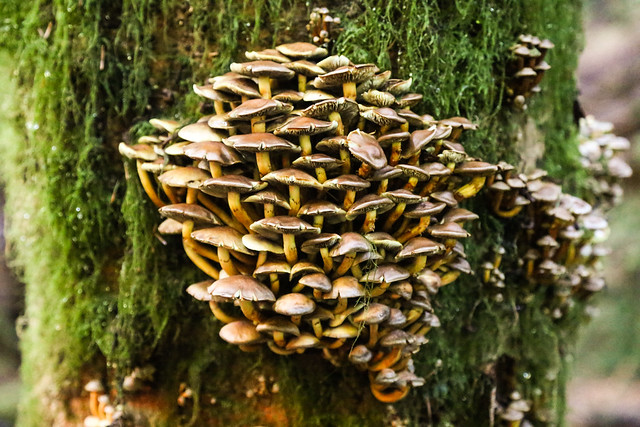
The photograph below shows a group of mushrooms growing along the side of a tree. Many wood-decaying fungi produce mushrooms in clusters, sometimes appearing to emerge from the bark itself.

Cluster of mushrooms growing from a tree along the Buntzen Lake hiking trails

A group of mushrooms growing along the side of a tree.

The next photograph shows just how extensively mushrooms can spread across a tree trunk. It almost looks as though they’ve taken over the whole tree!

Numerous mushrooms growing along a tree trunk near Buntzen Lake

Mushrooms covering a substantial section of tree trunk.

And here’s another impressive collection growing from an old stump. Dead wood is an important habitat for fungi, providing both moisture and an abundant supply of organic material.

Large collection of mushrooms growing from an old tree stump along the Buntzen Lake trails

A stump providing an excellent home for fungi.

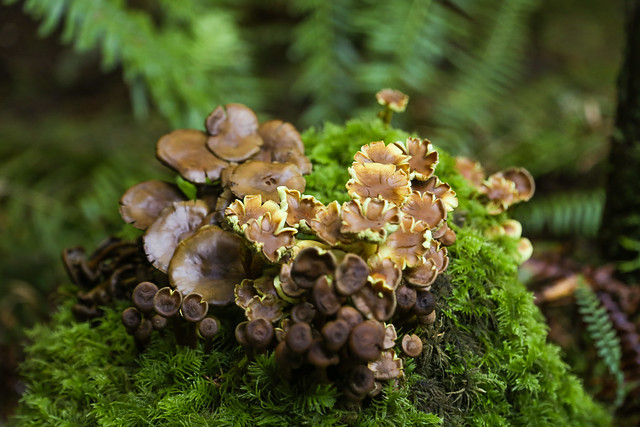
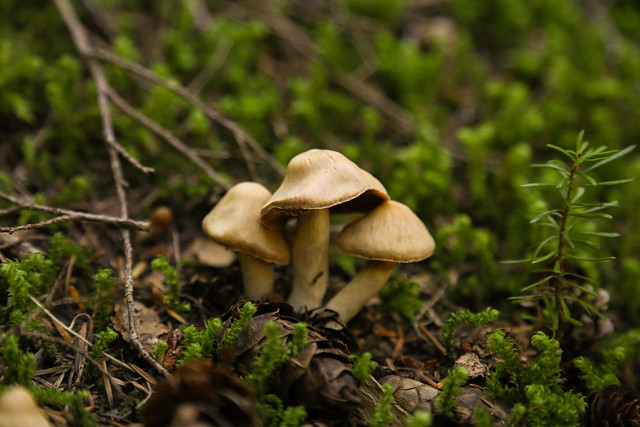
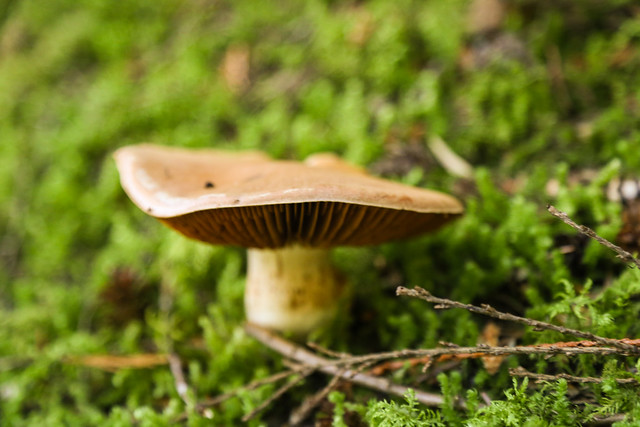
More Mushrooms Along the Trails

One thing I’ve noticed while hiking around Buntzen Lake is the variety of shapes, sizes, and colours. Some mushrooms grow individually, while others appear in groups. Some have the familiar mushroom shape, but others look quite unusual.

Here are three more examples I’ve photographed during my hikes.

Wild mushrooms photographed along a forest trail near Buntzen Lake

Close-up of a wild mushroom growing in the Buntzen Lake forest

Another wild mushroom encountered while hiking around Buntzen Lake

The visible mushrooms are actually just the reproductive structures of many fungi. Much of the organism can be hidden inside wood or beneath the forest floor as a network of fine threads called mycelium.

When conditions are favourable, the fungus produces mushrooms that release spores, allowing it to reproduce and spread.

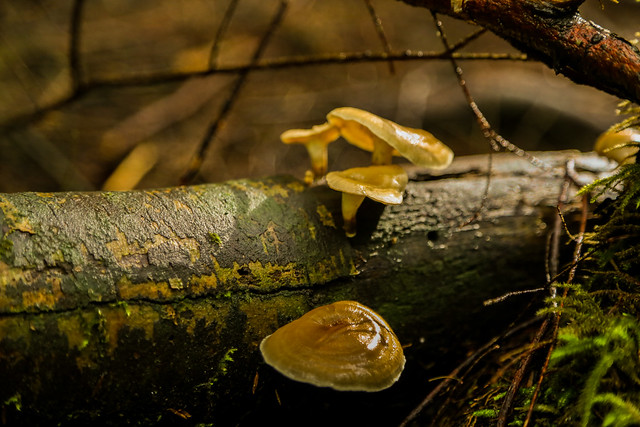
Interesting Yellow Fungi

Below is an interesting yellow fungus I’ve noticed in several places around Buntzen Lake. Its bright colour certainly makes it stand out against the darker bark and forest surroundings.

Bright yellow fungus photographed in the forest around Buntzen Lake

A bright yellow fungus that caught my attention.

Fungi come in a remarkable range of colours, including yellow, orange, red, purple, white, and almost black. Colour can sometimes help with identification, but it isn’t enough on its own to determine a species.

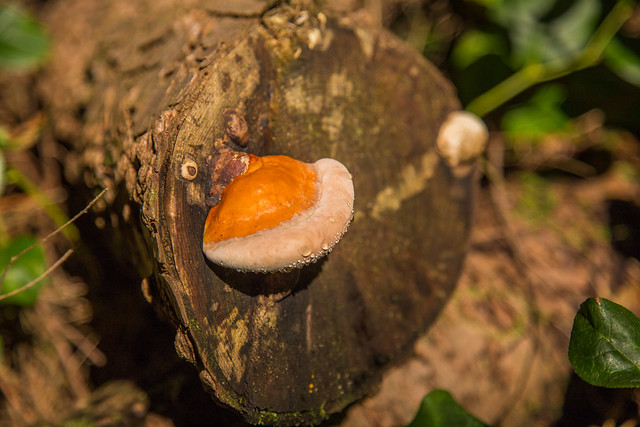
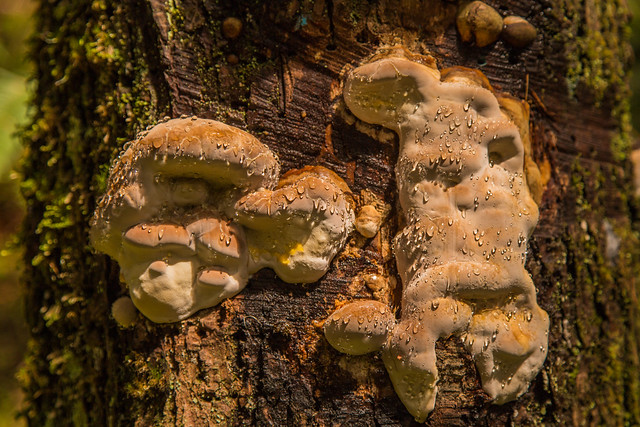
Are These Mushrooms Sweating?

The mushrooms in the next photograph look as though they’re sweating!

Mushrooms with visible moisture droplets on their surfaces near Buntzen Lake

These mushrooms certainly look as though they’re sweating!

Some fungi can produce visible droplets through a process called guttation, in which liquid is released onto the surface. Moisture droplets can also come from rain, condensation, or dew.

I don’t know which process explains the droplets in this particular photograph, but it’s an interesting feature.

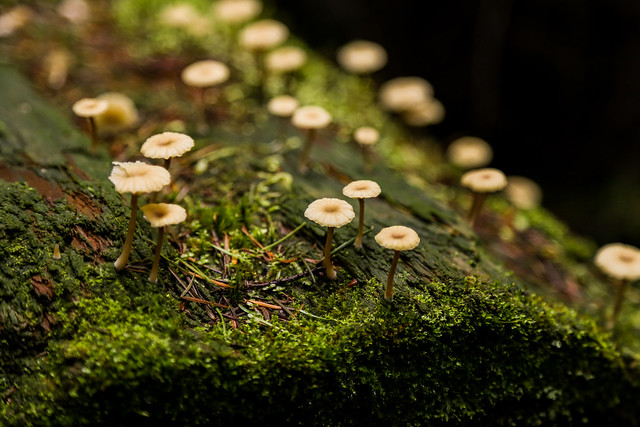
Tiny Mushrooms on the Forest Floor

Not all mushrooms are large or easy to see. Some are tiny and can be missed completely unless you slow down and look carefully.

Here are some little mushrooms I found along the trails.

Tiny mushrooms growing among forest debris near Buntzen Lake

Some tiny mushrooms that would be easy to overlook.

Small mushrooms can be particularly rewarding to photograph close up. Even ordinary-looking fungi can reveal interesting shapes, textures, and colours when viewed from a different perspective.

Unusual Fungi on the Lakeview Trail

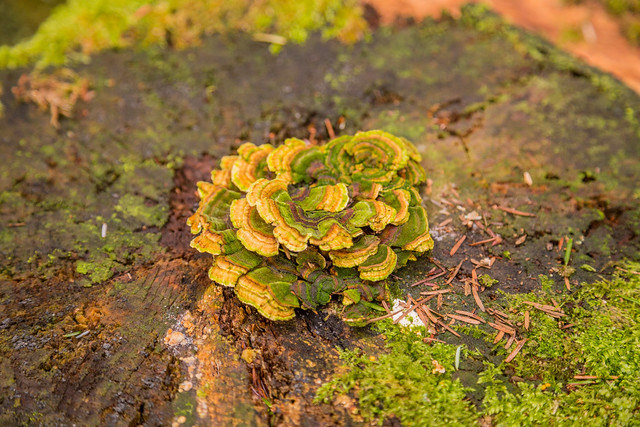
I’m not sure what the next one is, but I discovered it growing on an old stump along the Lakeview Trail.

Unidentified fungus growing on an old stump along the Lakeview Trail

An interesting unidentified fungus on an old stump along the Lakeview Trail.

Some fungi specialize in breaking down wood, including the tough compounds that give tree trunks their strength. This decomposition is an essential part of the forest’s natural recycling process.

Without fungi and other decomposers, fallen branches, logs, and dead trees would accumulate much more slowly decomposing, and nutrients would not be returned to the soil as efficiently.

Mushrooms Growing From Dead Wood

Here’s a small mushroom I found growing from the end of a dead tree.

Small mushroom growing from the exposed end of a dead tree near Buntzen Lake

A small mushroom growing from dead wood.

The next mushroom looks fairly normal, at least compared with some of the unusual fungi in the other photographs!

Wild mushrooms photographed along the trails around Buntzen Lake

A more familiar-looking mushroom.

White Fungi Growing on a Tree

The next two photographs show a group of small, whitish fungi growing on a tree, followed by a close-up of the same growth.

Small white fungi growing along the surface of a tree near Buntzen Lake

Small whitish fungi growing along a tree.

Close-up photograph showing the structure of small white fungi on a tree

A closer look at the same fungi.

Close-up photography can reveal details that aren’t obvious from a distance. For mushroom identification, mycologists often examine the underside of the cap, whether the fungus has gills or pores, its stem, and the material on which it is growing.

Orange Mushrooms Along the Buntzen Lake Trail

And finally, here are some funky orange mushrooms I photographed along the eastern side of the Buntzen Lake Trail.

Bright orange mushrooms growing along the eastern side of the Buntzen Lake Trail

Some bright orange mushrooms along the Buntzen Lake Trail.

It’s amazing how much variety you can find simply by paying attention to the trees, stumps, and forest floor while hiking.

Interesting Facts About Mushrooms and Fungi

  • Mushrooms are not plants: Fungi belong to their own biological kingdom. Unlike plants, they do not use sunlight to produce food through photosynthesis.
  • Most of the fungus may be hidden: A mushroom is often only the visible fruiting body. Networks of microscopic fungal threads called hyphae can extend through soil, dead wood, and other materials.
  • Fungi help recycle nutrients: Many fungi decompose fallen trees, leaves, and other organic material, returning nutrients to the forest ecosystem.
  • Some fungi help living trees: Mycorrhizal fungi form partnerships with tree roots. The fungi help trees absorb water and nutrients, while the trees provide sugars produced through photosynthesis.
  • Not all fungi grow mushrooms: The fungal kingdom includes yeasts, moulds, and many other organisms that don’t produce familiar mushroom-shaped structures.
  • Autumn is an excellent time to look: Wet weather and cooler temperatures often encourage mushroom fruiting in coastal forests. However, different species appear at different times throughout the year.
  • Some fungi can produce liquid droplets: Guttation is a process in which certain fungi release moisture onto their surfaces, sometimes making them appear to be sweating.
  • Dead wood is important habitat: Fallen logs and old stumps support fungi, insects, and other organisms. As the wood decomposes, it contributes to the nutrient cycle and helps maintain forest biodiversity.
  • Animals also depend on fungi: Various animals, including small mammals, eat mushrooms and other fungal structures. Some animals also help spread fungal spores.

Photographing Mushrooms Around Buntzen Lake

If you’re interested in photographing mushrooms, autumn is a particularly enjoyable time to explore the Buntzen Lake forests.

I find that looking at the sides of old tree trunks, decaying stumps, fallen branches, and mossy areas can reveal some interesting subjects. Sometimes the smallest mushrooms make the best photographs.

Try photographing fungi from different angles, including low to the ground, and look for interesting details such as gills, textures, and water droplets.

A little patience helps, especially when the forest is dark and damp. I also prefer to photograph mushrooms where they’re growing rather than disturbing them or removing them from the forest.

A Note About Mushroom Identification and Safety

Although I’ve included plenty of photographs, I haven’t identified these mushrooms to the species level. Many fungi look very similar, and accurate identification may require examining features that aren’t visible in a photograph.

Never eat a wild mushroom based solely on a photograph or an online identification suggestion. Some poisonous species closely resemble edible mushrooms, and mistakes can cause serious illness.

The purpose of this article is to appreciate and photograph the fungi growing around Buntzen Lake, not to provide a mushroom-foraging guide.

Please respect the natural environment, leave fungi and dead wood undisturbed, and stay on designated trails wherever possible.

Do You Recognize Any of These Mushrooms?

As I mentioned at the beginning, I’m a fun guy, but not a fungi expert!

If you recognize any of the mushrooms in my photographs, I’d be interested to hear your suggestions. Send me a message through my contact page and let me know which photograph you’re referring to and what species you think it might be.

Even after hundreds of hikes around Buntzen Lake, I still come across interesting fungi that I’ve never noticed before. That’s one of the things I enjoy about exploring these forests. There’s always something new to discover if you take the time to look.